Transcript:
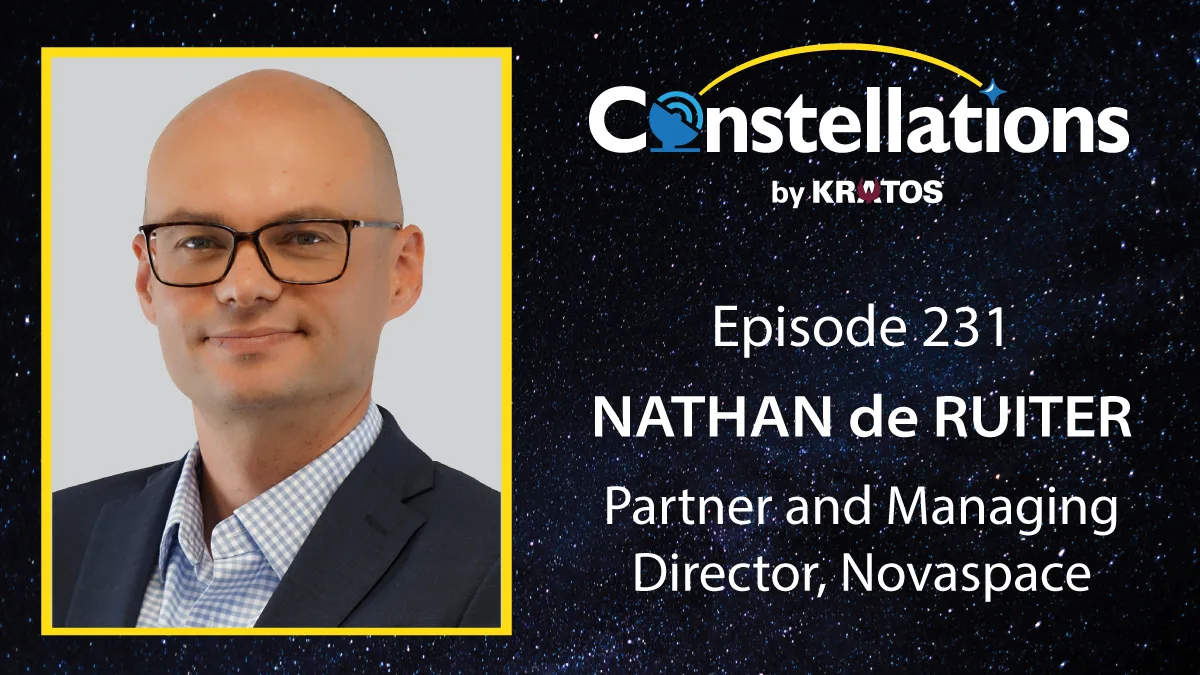
John Gilroy: Welcome to Constellations, the podcast from Kratos. My name is John Gilroy and I’ll be your moderator. Today, we’re looking at the supply and demand picture for satellite capacity in Asia and how it’s shaping the decisions operators are making across the region. Joining us is Nathan de Ruiter, partner and managing director at Novaspace, to help us understand what’s driving those shifts and what they mean for the competitive landscape in the years ahead. Nathan, you ready to jump in here?
Nathan de Ruiter: All right, I am.
John Gilroy: Good.
Nathan de Ruiter: Good to see you, John.
John Gilroy: Good. So, Nathan, what does the current supply-demand balance for satellite capacity in Asia, what does that indicate about pricing power across the region?
Nathan de Ruiter: Yeah. So, historically, we tend to look at Asia as a single supply demand market but, in reality, it’s really a collection of highly fragmented national market and in each shaped by its own regulatory environment, economic conditions and national policy. So, to give some perspective, Asia Pacific has traditionally been quite late in building some of this high throughput capacity and was often a little bit undersupplied. And even in 2025 when we look at the statistics, the region itself accounts only for 60% of the geo [inaudible 00:01:18] supply compared to North America despite having, say, about twice the land mass. So, that picture though is rapidly changing. First of all, we’ve just had a few days back the successful launch of device at F3 satellite which really will bring meaningful capacity into the region. And at the same time, obviously, the LEO constellation has pretty much changed the overrised supply-demand dynamic but it also brings to the key point. So, LEO capacity supply is still heavily concentrated by primarily Starlink and that’s really why you also need to look at it a country by country basis because, when you look at Starlink, you look at where they are present today, it’s about 29 of the, let’s say, close to 50 countries in APEC so there’s really still notably significant gaps in where they are active and where that capacity can be used. So, markets like Thailand, India, Pakistan, Vietnam, they don’t have that capacity today.
John Gilroy: Yeah, you mentioned China. As China expands its satellite and LEO capabilities, how is this shifting the competitive landscape for the other operators in Asia, that APEC you talked about?
Nathan de Ruiter: Yeah, I think there are really two sides to this story. So, on the one end, China is expanding satellite and LEO capabilities can really create a competitive front to the existing operators in the region and that competition can really show up in terms of throughput but also on price as well although we’re still trying to figure out what the pricing strategy would be of those Chinese constellation when they actually are fully deployed. But you could also see it as a bit of an opportunity for operators in the region because it also provides more choice for them and greater flexibility for those regional players and I can give you an example there. I think MEASAT in Malaysia was one of the first resellers of Starlink in the country but then Starlink also decided to add other resellers in Malaysia. And against that backdrop, basically, MEASAT had decided as well to look at for other options and they became the first international partner of the China Thousand Sails constellation. So, here is a good example of this provides an opportunity or more opportunities for the existing players in the market and they can position them a little bit differently in a, I would say, increasingly competitive market.
John Gilroy: Oh, it is a rapidly changing market, it’s tough for me to ask the long-term question but I’m going to ask it anyway. With major players like China and India accelerating launch and manufacturing capability, how are these regional operators adjusting their long-term fleet plans if they have any plans, huh?
Nathan de Ruiter: Yeah, no, they have plans and definitely they are seriously reviewing those plans and, again, it comes a little bit to the earlier point. Obviously, you can see it as a competition but also, and let’s take the positive spin here, it also becomes this optionality for them to benefit from those new capabilities coming to the markets. And it’s also fair to say, if you look at these regional operators today, they’ve been struggling to close the business case based on the existing solutions out in the market. So, we see now KT SAT, for example, in Korea, looking at and signing deals with new solutions like an Essent ARC geo platform to really try to find a more competitive way and a more capital efficient use of these capabilities. And I think there’s similar opportunities as well around India and China solutions and, in the region, obviously, there has been long historic ties between different countries with India and China. So, again, we believe that those partnerships are becoming more prominent in the next few years. The other side question though still most of these capabilities in China and India are also built to meet their own demand so it’s still the question out there, once they meet their own national demand, is there still capacity available for them to serve as well international clients. And I think that’s still a question we would like to see in the next few years if that’s really become available to other regional and international players.
John Gilroy: And, Nathan, you’ve been involved in this business for a long time, you probably observed something I had, the word sovereign seems to be coming up more and more just in the last five or six years. So, as governments invest more heavily in sovereign connectivity programs, how is this changing the structure and duration of commercial capacity agreements?
Nathan de Ruiter: Yeah, we’ve definitely seen some changes in there. So, first, there’s true, there’s a growing interest from governments and having dedicated satellite support, national sovereignty requirements and we’ve seen it quite recently in Philippines, for example, strong government support in procuring some satellites from Astranis, for example. But also these satellites take time to build, they talk about multi-year gaps so there’s always this time between the intent and the operational reliability. So, we still see quite a bit of capacity agreements as a temporary gap filler till those new programs are becoming available. I think the second part of the story here and the change is also a little bit generated by Starlink, they are definitely more built around not necessarily long-term fixed contracts so much more flexibility in usage and in contract terms and that really has reset expectations as well in the market. So, most of the government and end users are increasingly pushing for more flexibility than these very traditional long- term agreements. And finally, I think there’s a still important part, the sovereignty requirement also comes back to the question for a lot of these countries to not be fully dependent on a single operating system. So, I think beyond what you would also see, they will not probably bet on a single solution, you will probably expect a more layered approach, I think, with different solutions and really balancing the speed and ability to address the market needs now but also to maintain national control.
John Gilroy: As satellite and terrestrial networks move towards shared standards, which aspects of that convergence are most likely to reshape service delivery models?
Nathan de Ruiter: Yeah. When we talk about convergence between satellite and terrestrial networks, the most visible and immediate impact is clearly in this direct to device and IoT arena. So, this is where standards are already reshaping service delivery models, we’re seeing these commercial D2D services already live in markets like Japan, Australia and New Zealand. And actually, according to a recent study by OCLA, Australia is now the second largest D2D market globally after United States so there’s a clearly leading role of some of the Asian countries next to, I would say, Australia. Japan stands out with all the M&Os basically being engaged and signed up to deliver D2D services. So, it’s not really an experimental projects anymore, it really turns into real adoption. But on the longer term, however, the bigger impact of convergence probably will come more from fully integrated systems. So, think about true convergence by coming, embedding basically different parts of the mobile networks and not necessarily being in a satellite being the bold-on service solution. I think here what we probably expect to see over the long-term is when you basically really bring all the different layers of telco, satellite solutions altogether and really where we would see, instead of a separate terrestrial and satellite offering, operators being able to ploy more unified satellite plus terrestrial network stack. And in practical terms, that means that countries already using, for example, an 4G, 5G infrastructure could eventually be approached with an integrated 6G offering that really includes satellite connectivity by default rather as an add-on. So, again, I think the convergence is just at a starting point but, again, in the future, we’ll be moving to more this truly seamless, ambiguous network where a satellite is built in from day one.
John Gilroy: Well, speaking of networks, let’s focus on the ground here a little bit. Where are operators concentrating their ground segment modernization efforts and what strategic or maybe even operational drivers are shaping those decisions?
Nathan de Ruiter: Yeah. So, globally, sell it operators are really focusing on their ground segment modernization primarily around the software layer so things like orchestration, automation and dynamic traffic management. And the reason for that is now that we have this influx of capacity and the multi-orbit networks, LEO, MEO, GEO, all working together but that capacity is only useful if it’s coordinated intelligently from the ground. So, just adding bandwidth doesn’t create value if you can’t route traffic, aggregate links and allocate it in real time. So, this is strategically what’s happening, this is what the shift basically is. So, customers today, they really expect this integrated service-driven solutions and, again, so the ground segment is basically the orchestrator of that and becoming a real differentiator. And operationally, of course, it’s all about scalability and cost and this is where automation really comes into play to really scale these solutions without spiralling the cost out of control. Now, the other point I think specifically about Asia is that it’s not just a modernization story, there’s also this structural challenge with regulation and sovereignty. So, first, you’ve got these requirements in countries like India and Vietnam where the data needs to be handled within the country and cannot leave the border so that’s really pushing operators to build these localized and country-specific gateways rather than relying on more regional teleports. And also there’s a strong push for some of the countries to control the ground segments so governments really want to have this end-to-end control of communication networks. So, again, here is where I think and specific to the Asian region is it’s about localization, it’s about sovereignty and layering that all together in a meaningful way so, in a certain way, the ground segment is becoming not just a technical or strategic asset but also a geopolitical one.
John Gilroy: Well, we can delve into this whole network architecture topic for a while here. So, how are operators adapting network architecture and service commitments as cybersecurity and data sovereignty rules grow more stringent across Asia?
Nathan de Ruiter: Yeah, these issues are becoming increasingly important especially in today’s environment. So, what I’m seeing is that the operators are still assessing cybersecurity and data sovereignty requirements much more on a country-by-country basis rather than a one-size-fits-all solution. Anecdotally, recently we saw the Chinese constellations tend to be more flexible around the data landing requirements than for example, SpaceX. And there was an example in Kazakhstan where Starlink was initially selected to connect a large school network but the radar declined to build a local gateway in the country and that’s why the project never materialized. And about six months later, the [inaudible 00:13:36], the Chinese constellation established a local subsidiary and basically was able and willing to meet those, comply to the regulations and be able to directly serve that market. So, again, different approaches and each of the operators have to make these decisions on a country by country basis.
John Gilroy: Mm-hmm, yeah. With more countries relying on commercial earth observation data to strengthen deterrence, how is AI improving early warning and decision support capabilities?
Nathan de Ruiter: Yeah. One of the big trends over the last 12 months is clearly, across Asia, is a big push towards investment in earth observation capabilities and commercial EO data and AI is central as well to this shift to really benefit from those capabilities in a few ways. So, first we see AI is changing how satellites handle the data at the source. So, EO satellites collect a lot of imagery and, in many cases, not all of that imagery is valuable or useful either due to cloud cover or other poor angles or other less relevant images being taken. So, again, the AI processes on board will help to filter the good, let’s say, images and be able to only downlink the data that is really needed. The second part obviously is, as the data availability grows, AI becomes essential on the ground as well. So, instead of having analysts manually sifting through images, AI models can help to analyze these massive datasets to detect changes which is, obviously, a key user application of the EO market. And then the next step and arguably the most important one is predictive analytics. So, AI does not just detect activity, it can start to anticipate behavior and that includes, for example, true movements or probability to assess certain specific conflict scenarios. So, it’s really becoming the ability of AI to bridge a gap between observation and foresight and there are examples, I think, in Asia where we see that being implemented. And again, I think going forward, this AI central really depend how quickly we can scale the EO market.
John Gilroy: Yeah. Nathan, earlier you mentioned those 50 countries in APEC and so many different flavors in Asia, all kinds of different ones out there. So, how are operators approaching financing in an environment where capital access, state involvement and risk tolerance vary so widely across these Asian markets?
Nathan de Ruiter: Yeah, yeah. Operators across Asia are having to rethink how space assets are financed especially in this rapidly changing market environment. Traditional this balance sheet heavy solid ownerships that have worked for decades don’t really make so much sense in this new environment and we are seeing now growing interest in alternative financing models. So, there are companies like Space Leasing International, they play an interesting role here, they basically procure new satellite technology and allowing operators to access the capacity without taking up full upfront capital burden. So, that approach can really be helping and quite critical in markets where financing is tight and technology risk is potentially higher. So, there’s a real untapped opportunity, I think, to apply these financing structures that are also used already in other industries like aircraft leasing, for example, and apply that to the satellite industry. So, that would help operators to free up capital by selling capacities, satellites as well, existing satellites and leasing them back to other entities. And again, this is, I think, one of the ways we would see a more intelligent use of the capital and also a much lighter financing structures for operators to manage their business.
John Gilroy: So, Nathan, which partnership models are gaining traction as operators look to expand geographic reach, diversify services or maybe even enter new verticals?
Nathan de Ruiter: Yeah, there are a few partnership models that come to mind. The first is distribution partnerships which are fundamentally about building skill and gaining market access. So, operators, they’ve been increasingly partnering with telcos and local resellers to penetrate markets that are difficult to access or highly regulated, I think India is the prime example here, so I think all satellite operators have been positioning. So, OneWeb, for example, established a partnership with Warti, Starlink has been engaging with multiple domestic telcos and these arrangements really allow those satellite players to leverage existing distribution channels and the client relationships those telco partners have. Another model is what we call more a platform and ecosystem system-based partnerships. So, this is where satellite operators and telcos are effectively merging their commercial ecosystems so satellite services being embedded in their billing systems and really bundled into terrestrial, non-terrestrial network solution. And in some cases also extends to cloud partnerships, actually, where satellite connectivity is coupled with edge computing and cloud infrastructure and managed services. So, really those services and partnership models together really shift from what is historically be a very narrow satellite focused service offering to a more integrated collaborative approach to, again, to the goal to scale and expand reach.
John Gilroy: How are operators positioning themselves in maritime aviation and rural connectivity markets and which commercial models are showing the most scalability?
Nathan de Ruiter: Yeah. So, across maritime, aviation and rural connectivity, we see a clear split between our global scale players and more targeted operator strategy. So, the most scalable commercial markets are actually being captured by the virtually integrated players like Starlink and Amazon LEO because they can really drive the scale, maintain control in terms of high volumes, economies of scale that can really lead to aggressive pricing. So, as a result, I think the operators, the traditional ones or the regional ones are better to focus on more insulated and defensible opportunities where they can really deliver value rather than compute purely on scale and there are different examples for that. I believe one of the examples we see today still in the market is the rural connectivity, obviously, providing connectivity to more rural villages or population, it remains a very government-led vertical and there’s many programs that, in Indonesia, Malaysia, Philippines, very well-known programs that are funded at a national level and really serve and being implemented by better provincial and municipality authorities and operators that succeeded in these programs tend to fall in one of the two categories. So, either being the foreign players with the right capacity at the right time so that’s particularly what we’ve seen on the Indonesia’s BAKTI Program or the other successful were the strong local champions like a local domestic operator like MEASAT being successful in Malaysia with the JENDELA Program. So, in general, overall, I would argue that scalability today favours the big constellations and traditional operators are more carving out their strategic positioning and more closely allowed to governments and specific market opportunities that are not easily addressed by those bigger constellations.
John Gilroy: I’m sure everyone listening to this podcast realizes how big the market’s growing in Asia. And as Asia’s satellite sector matures, which strategic decisions facing operators today are likely to have the most lasting impact on this competitive landscape?
Nathan de Ruiter: Yeah. This really gets to the heart, I think, of the issue faced by satellite operators in Asia today and many of them are going to what I sometimes call effectively a midlife crisis. They’re asking themselves, who are we, are we a regional satellite operator, are we a managed service provider, are we a national space tech champion and they’ll have to make the decision on this identity question and that will really determine how the competitive landscape will shape up over the next few years. One of the key debates in the market still is the geo versus NGSO debate and Asia’s a highly fragmented and politically complex region which I think we’ve talked already quite a bit about. So, it’s very hard to as a nation build your own Pan-Asian and geo satellite constellation so in what I would expect is that the Cape efficient flexible geo satellites will continue to play a critical role especially for meeting those sovereign demands. So, all in all, I think there is quite a bit of opportunity for the regional operators but, again, they have to make the decision whether it is sovereign focused, whether it is a full space tech defines delivery or maybe a more managed service provider where you combine the telecom and the satellite solutions jointly and reposition yourself to that market. So, yeah, some big decisions to make but I think, the longer we’ve done so much opportunity into the market, I think there’s enough room for many of these players to be quite successful.
John Gilroy: Nathan, I think you’ve given our listeners a real good handle on satellite capacity in Asia. I’d like to thank our guest, Nathan de Ruiter, partner and managing director at Novaspace.
Nathan de Ruiter: Thank you, John.