



4 Takeaways: The Ground Segment’s Shift to Software, Cloud and Automation

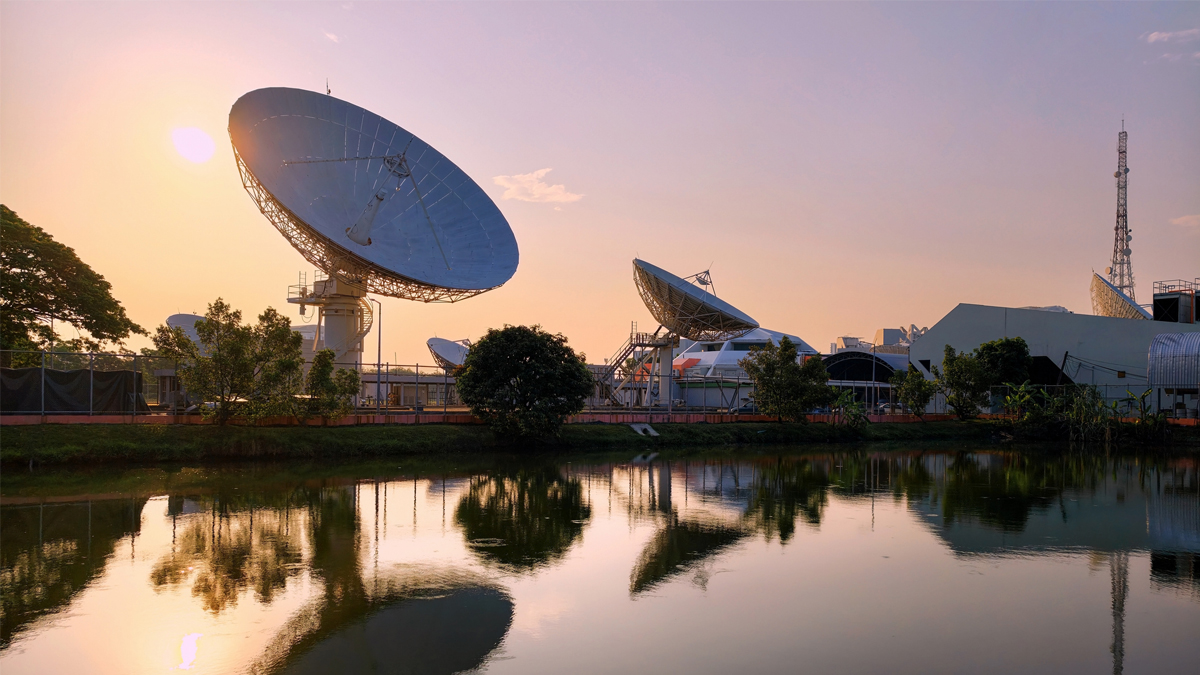
Demand for flexible, scalable and cloud-enabled space operations is rising fast. As constellations grow and missions diversify, the ground segment is undergoing one of the biggest transformations in its history – toward automation, service-based models and global interoperability.
Read our top four takeaways from our conversation with SSC Space’s Jonas Åslund and Victor Pankov, or listen to the full episode.
Takeaway 1: Commercial constellations are pushing the industry toward agile, software-defined ground systems.
The shift from government-led programs to commercial constellations has fundamentally changed infrastructure requirements because operators now need scalability, higher data rates and real-time responsiveness, Jonas Åslund, product manager at SSC Space, said on the podcast. Mission profiles are more dynamic, satellites are smaller and more numerous, and the hardware-centric systems of the past simply can’t keep up, he said.
“The shift, from what we have seen, is based on dedicated hardware and getting that into more software-defined, more agile systems…” Åslund said.
Meanwhile, multi-orbit missions are forcing ground networks to be far more adaptable. “We need to be really flexible and our infrastructure should be able to handle not just a certain subsection of missions, but the whole gamut,” said Victor Pankov, product owner at SSC Space. IoT and EO constellations are advancing quickly, and ground systems must evolve at the same pace, Pankov said.
Takeaway 2: Cloud-enabled operations dramatically reduce time-to-insight and increase mission flexibility.
Cloud adoption is reshaping how operators process data and scale missions, said time-sensitive missions now depend on cloud-based processing and ground-stations-as-a-service to achieve near-real-time intelligence, Pankov said.
“What we are really trying to enable with our cloud-based ground stations as a service offering is time to insight,” Pankov said. With cloud-based ground systems, operators can download imagery and generate actionable awareness in minutes – a capability that legacy on-prem systems cannot replicate, he said.
Hybrid approaches combining cloud and on-prem systems support sovereignty requirements, enable global reach and allow operators to upgrade capabilities without replacing physical infrastructure, he said.
Takeaway 3: Automation and AI are becoming essential for operational efficiency, scalability and constellation management.
Automation supports everything from scheduling to orchestration to data routing. It also reduces operational burden and cost while enabling far more complex mission operations, Åslund said. Automated scheduling alone gives operators significant efficiency gains, he said.
Operational scaling simply isn’t possible without AI, especially for large constellations. “Imagine this. You have a constellation of 300 satellites. You have three operators on your night shift. They’re not going to be able to schedule contacts with 300 satellites,” Pankov said. AI systems evaluate constraints, plan contacts, assign ground passes and optimize payload tasking – capabilities human operators cannot perform at constellation scale, he said.
AI also enables predictive maintenance on antennas and RF equipment. “It’s looking at how our antennas perform… maybe this antenna’s moving slightly too slow,” Pankov said. That insight allows teams to fix issues before failures occur, reducing downtime and protecting mission performance, he said.
Takeaway 4: Hybrid, global and lunar-scale networks are redefining mission reach and operational complexity.
Operators increasingly rely on hybrid ground networks that combine owned infrastructure with global service providers. This model delivers sovereignty and resilience while enabling worldwide reach, Pankov said. “At the end of the day… the industry’s looking for a service, not looking to build,” he said.
These architectures become even more critical as missions expand beyond Earth orbit. SSC supported the first commercial Moon landing – a milestone that introduced operational challenges. “Getting to the moon and the distance to the moon – it adds a lot more complexity if you compare it with, let’s say close-to-earth operations.,” Åslund said. Long-distance communication requires deep-space networks, global coverage and precise coordination, he said.
Future lunar missions will depend on seamless connectivity between terrestrial, orbital and lunar networks, Åslund noted. “If you combine these… and have intelligent data handling… you can find good solutions to have seamless operations,” he said.
For more, listen to the full episode.