



4 Takeaways: What Actually Drives Success in Modern Space Missions

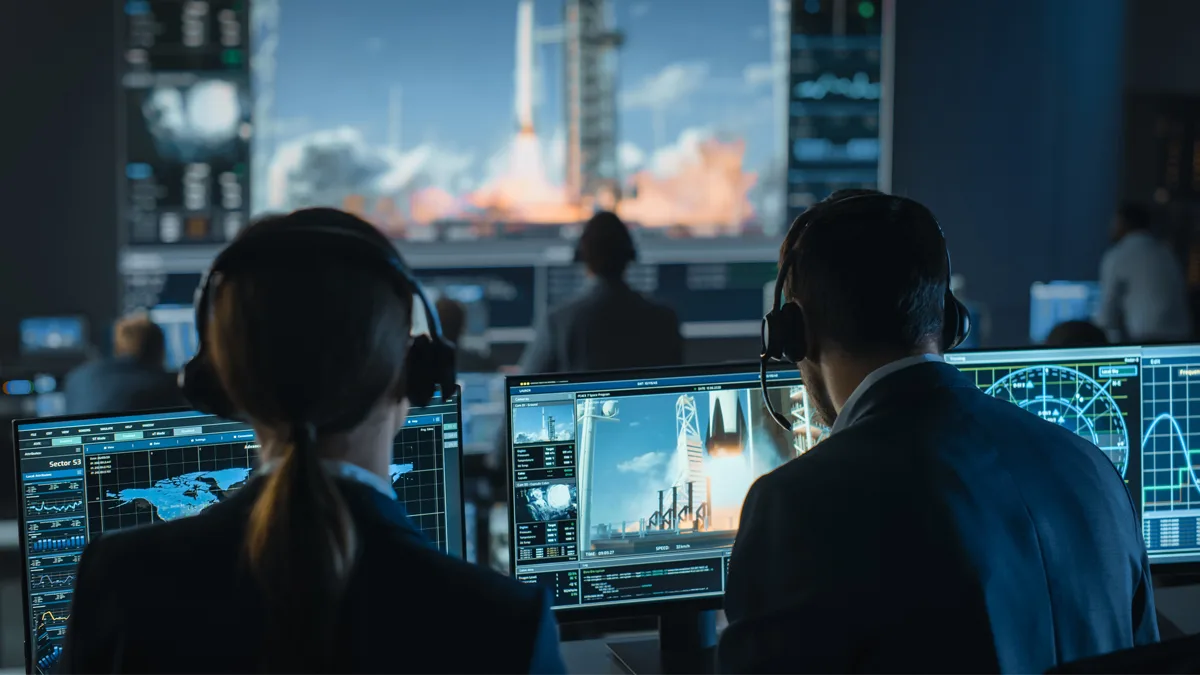
For years, space missions have been evaluated through visible milestones: launch success, satellite performance and the volume of data returned to Earth. That model has helped define progress across the industry, but it no longer captures what actually determines whether missions succeed.
At the recent 41st annual Space Symposium, one theme was clear: Space is becoming an increasingly interconnected and at times contested operational ecosystem. Against that backdrop, Space Foundation’s Melanie Stricklan pointed to a different set of factors shaping mission outcomes—ones that are far less visible from the outside.
As architectures expand across space, ground and cloud—and as operations become increasingly software-defined—decision speed, system alignment and the ability to adapt under pressure are beginning to outweigh traditional measures of capability.
Read our top four takeaways from our conversation with Melanie Stricklan, executive director of SWFT, and chief innovation and advancement officer at Space Foundation, or listen to the full episode.
Takeaway 1: Space Missions are no longer discrete systems—they are continuously adapting ecosystems.
Satellite operations may appear straightforward from the outside, but launch is only the prelude of a “long campaign of systems engineering,” according to Stricklan.
“From the outside, satellites operations … look a little solved … You launch, you point, you downlink, and you get your answers,” Stricklan said. “In reality, launch is just the very beginning.”
Modern missions now span tightly coupled layers, including spacecraft, ground systems, cloud infrastructure, spectrum and an increasingly contested orbital environment. These elements don’t operate independently – they interact continuously, often in unpredictable ways, said Stricklan.
“We’re really no longer operating individual satellites … we’re operating tightly coupled cyber-physical systems,” she said.
As a result, operations are evolving from managing known conditions such as adding hardware and radiation effects to adapting in abnormal environments where operators must account for the behaviors of other satellites in addition to their own, Stricklan said.
“The complexity really isn’t just technical anymore. It’s that modern space operations layer upon layer that behave less like a machine and more like a living system,” she said.
Takeaway 2: The center of gravity has shifted from hardware performance to decision speed.
Historically, space mission performance was tied to the capabilities of individual platforms: satellites, sensors and launch systems. That is changing, according to Stricklan.
“For decades, the center of gravity was the platform … and today, the center of gravity is increasingly that orchestration layer – the software, the data, the operational systems and subsystems that coordinate assets across ground, space and the digital realm – the cloud, etcetera,” Stricklan said.
As complexity increases, the ability to move and act on information quickly is becoming more important than the performance of any single event, she said.
“The vantage point is really shifting from hardware performance to decision speed,” she said.
The shift is also changing the role of operators, who are now focused less on controlling individual spacecraft and more on managing the flow of data and decisions across distributed systems, Stricklan said.
Takeaway 3: AI is compressing decision cycles—but trust, not performance, is the limiting factor.
AI is already playing a central role in modern space operations by helping process vast volumes of data, detect anomalies and surface relevant signals.
In many ways, it is becoming the connective layer that allows operators to make sense of increasingly complex systems, Stricklan said.
“[AI] is becoming the nervous system for those complex architectures that we talked about, helping operators see what matters across those systems that would otherwise overwhelm the human attention,” she said.
But as AI moves closer to operational decision-making, new challenges emerge. Beyond assessing whether the model works, operators will need to determine if it’s understandable, governable and if they can trust its outputs in dynamic and contested environments, Stricklan said.
“We’re at the point of designing systems where humans have to be able to trust … to supervise that trust parameter and then adapt AI behavior when the environment changes,” she said.
Organizations that can manage AI through establishing boundaries and adapting its behavior amid environmental changes will have an edge as AI becomes increasingly integrated into space missions, said Stricklan.
“The winner will not be organizations that deploy the most satellites or the most AI. They’ll be the ones that can close the AI-enabled decision loop quickly as it continues to evolve at a pace that we’ve not seen before and understand and govern that outcome.”
Takeaway 4: The biggest barrier to scaling automation is not technology but misalignment.
Despite rapid advances in AI and automation, the primary obstacle to scaling across multi-orbit, multi-provider environments is not technical, according to Stricklan.
“The biggest barrier isn’t tech. It’s not algorithms. It’s the seams between systems, between organizations and behavior,” Stricklan said.
Even when systems are connected through APIs, they often interpret key concepts—such as priority, availability or confidence—differently. Humans can resolve those differences through context, but machines cannot, Stricklan noted.
“I think in automated environments, we’re going to see that definitions become operational infrastructure,” Stricklan said.
“So different teams use same terms … but the meanings are different,” she noted, adding that semantics are already different across commercial, civil and defense operations today.
As automation increases, those small semantic gaps can lead to diverging decisions at scale, said Stricklan.
The implication is that shared definitions and operational alignment are becoming a form of critical infrastructure for modern space missions that factor into how far systems can evolve, she said.
“And so, I think that automation and AI will scale when systems interpret information the same way, not just when they exchange it,” Stricklan said.
While space operations continue to evolve, the factors that determine success are becoming less visible but more consequential. Missions will increasingly be defined not by what is launched but by how effectively systems, data and teams work together across a complex orbital domain.
For more, listen to the full episode.