



Amazon Leo: We’re On Track for Initial Service This Year; Vulcan, Ariane 6 Launches Expected ‘Within Weeks’

Originally published by Space Intel Report. Read the original article here.
Amazon Leo said it still expects to begin initial broadband service this year following the company’s first launch on the United Launch Alliance Vulcan rocket and its third flight on Europe’s Ariane 64 vehicle — both expected “in the coming weeks,” Amazon said.
In an Oct. 8 update on its satellite production, the company said it recently completed its 1,000th satellite despite having launched only 396 so far as it waits for launchers to become available.

“Completed satellites ship to Florida every two to three days,” the company said. “At Amazon’s payload processing facility at Kennedy Space Center, the team has hundreds of satellites on standby for launch, ready to fly in as little as three weeks’ notice.”
“We solved the production problem,” Paul Palcisco, head of satellite production, said in a statement. “Now we’re ready to go as rockets become available. There should never be a day when a launch slot opens up and we don’t have the satellites ready for it.”
The satellites for the upcoming Vulcan and Ariane 6 launches have already been stacked on payload dispensers at their Cape Canaveral and French Guiana launch sites.
The Vulcan launch, scheduled for the end of this month, is expected to carry 40 Amazon Leo satellites, each weighing some 500 kilograms.
The Ariane 6 manifest has been stalled since an August discovery of an anomaly in one of the rocket’s turbo pumps. The glitch will likely mean that two launches of the European Commission’s first-generation Galileo positioning, navigation and timing satellites into medium Earth orbit, scheduled for this year, will slip into early 2027.
Launch service operator Arianespace has not confirmed a new Ariane 6 schedule. After the Amazon mission, carrying 36 satellites, the vehicle’s lighter Ariane 62 version had been scheduled to launch the Metop-SG-B1 polar-orbiting meteorological satellite for Europe’s 30-nation Eumetsat organization.
The Amazon Oct. 8 update confirms the hidden cost to the company of the launch bottleneck, a situation the company had hoped to avoid by purchasing more than 100 launches on multiple heavy-lift vehicles.
The company said the launch diversity “[gives] it plenty of launches during a period when commercial launch capacity is increasingly scarce.”
That was the idea, but it didn’t account for the delays experienced by just about all its launch providers.
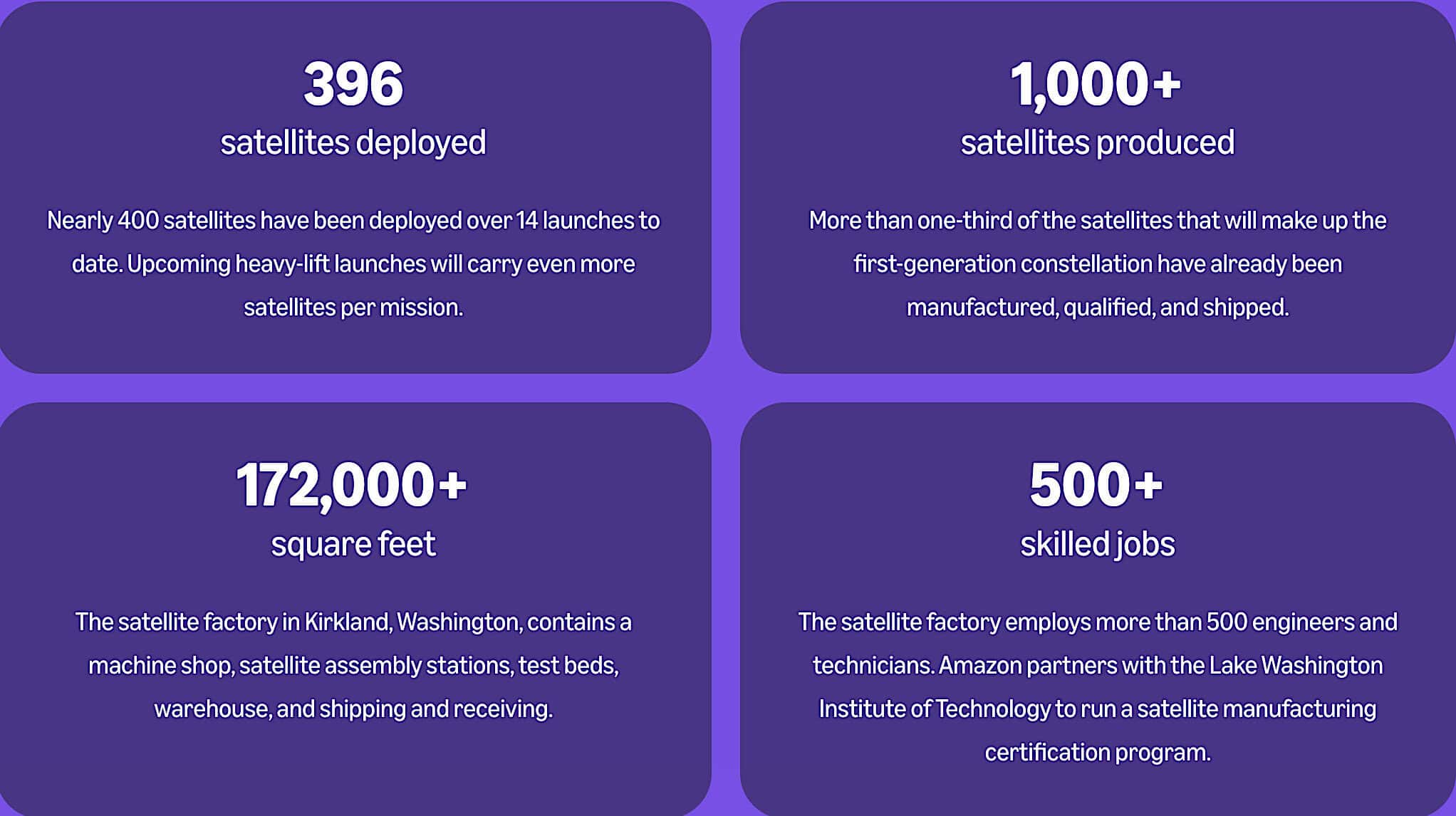
The company’s Kirkland, Washington, satellite manufacturing facility experienced its own delays early in the development program but now “has the capacity to produce five satellites per day,” Amazon said.
Pressured by regulatory deadlines to meet its targeted production rate, Amazon said its Kirkland facility “ran around the clock — multiple shifts, up to 20 hours per day.”
During this period it streamlined its qualification process to days from months “while sustaining an on-orbit success rate that surprised even the most optimistic on the team.”
Four Amazon Leo satellites have been deorbited
“Of the 396 satellites launched to date, only four satellites have been deorbited.”
In hindsight, the round-the-clock production effort and the increase in labor and other costs appears unwarranted given the hundreds of satellites now in storage and awaiting launch slots.
The company said it is improving the satellites’ performance with an upgraded propulsion system with twice the thrust of the early Amazon Leo satellite design. The new system will fly starting early in 2027, Amazon said. It’s not clear whether these satellites will jump the queue of spacecraft to be tested early next year.
“The added propulsive thrust also increases the efficiency of every satellite maneuver, improves the time for satellites to reach their operational orbits and increases the orbital lifetime of the satellites, allowing them to keep working through cycles of heightened solar activity and atmospheric drag,” the company said. The current Amazon Leo satellites have an expected service life of 5-7 years.
Amazon Leo is also readying its production line to build direct-to-device mobile communications satellites following the company’s $11.57-billion purchase of Globalstar, whose principal customer is Apple.
Originally published by Space Intel Report. Read the original article here.