



ESA Awards $634 Million in European Launcher Challenge Contracts to Isar, PLD, RFA; MaiaSpace Deal To Follow

Originally published by Space Intel Report. Read the original article here.
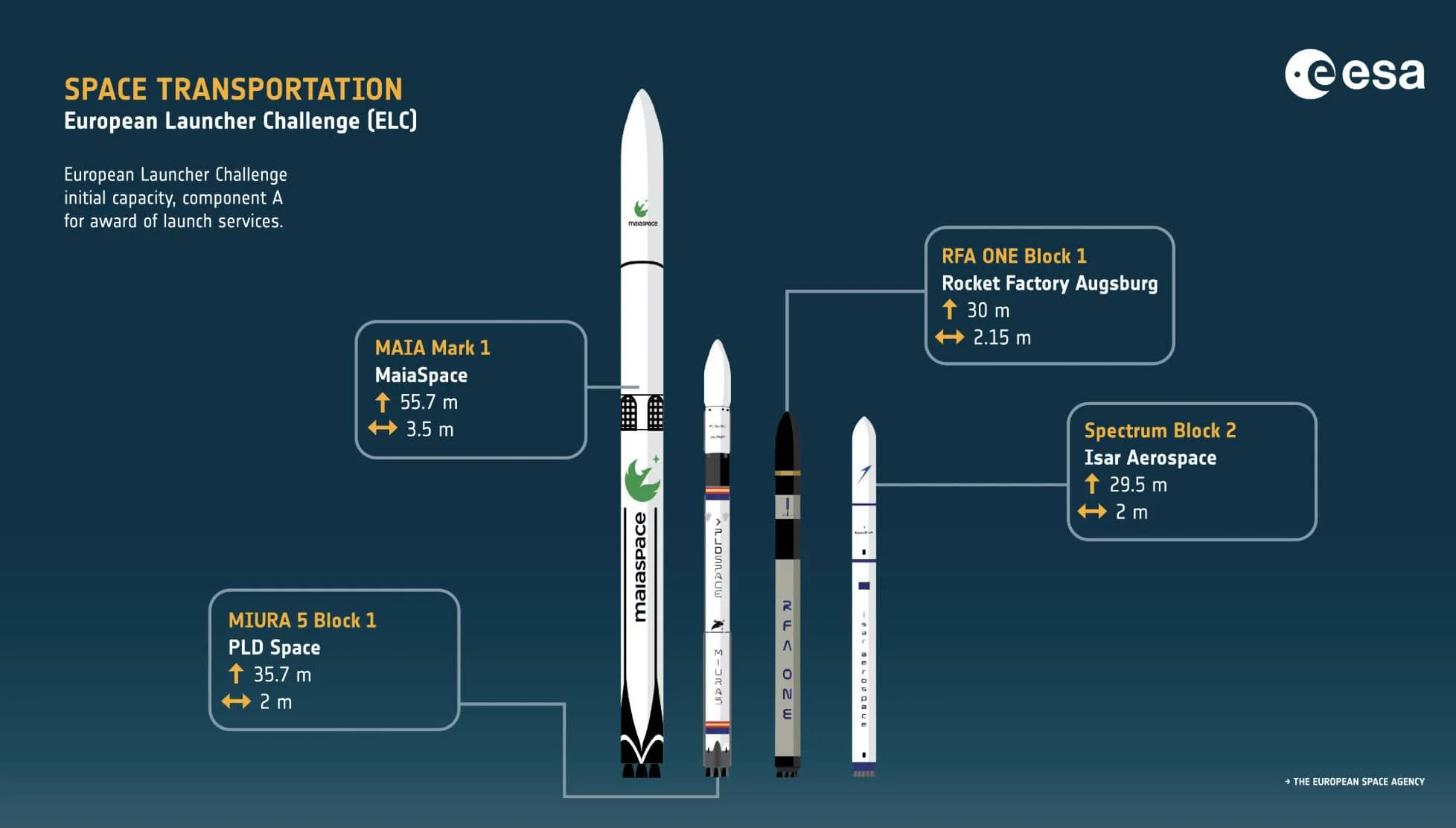
TUPPER LAKE, NY— All three startup launch service providers that on Aug. 27 were awarded a combined 543.6 million euros ($633.8 million) in European Launcher Challenge funding over the next three years had originally promised inaugural orbital flights in 2026.
With four months to go in the year, the question is whether any of them — Isar Aerospace, PLD Space or Rocket Factory Augsburg (RFA) — will meet this goal.
Long gone is the heady enthusiasm of these companies’ early days and predictions that one or more of the New Space launchers would be in orbit before the first flight of Europe’s long-delayed Ariane 6 heavy-lift rocket.
Ariane 6’s inaugural flight, a demonstration mission, was in July 2024. it conducted four successful launches in 2025 and four so far in 2026. Its ninth operational launch is scheduled for Aug. 27. Launch service provider Arianespace is sticking with plans to conduct seven or eight launches this year on the way to ramping to Ariane 6’s nominal flight rate of 9-10 per year starting in 2027.
ESA’s European Launcher Challenge (ELC) collected some 900 million euros from ESA member governments at ESA’s November 2025 ministerial conference — far more than was expected, and more than ESA had asked. The figure includes 112 million euros from the UK which has not been distributed following the shutdown of Britain’s Orbex Space.
Four ELC challengers were left — the three above plus MaiaSpace of France, which has always said its first orbital flight would be in late 2027.
ESA said on Aug. 27 in awarding the three awards that a similar contract with MaiaSpace was in the works.
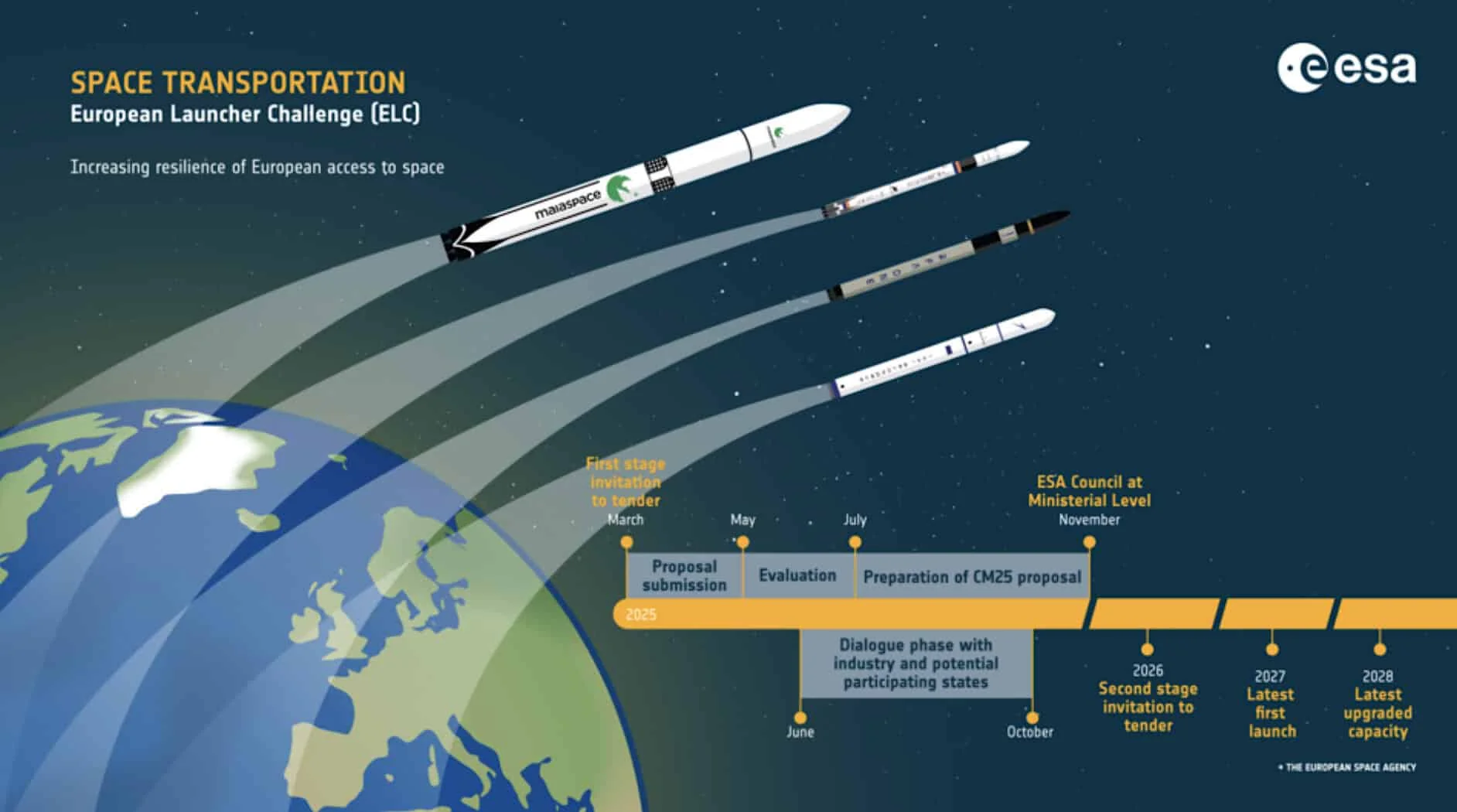
Funding for this second phase of the ELC program is based on milestones. The most important is an orbital flight of the four companies’ current vehicles by the end of 2027. A second deadline, in 2028, is a demonstration — not necessarily a successful orbital flight — of the companies’ ability to move to larger-capacity rockets.
It became obvious in the run-up to the November 2025 ministerial that ESA is less interested in having four small rockets than having one or two capable of growing to offer, by the early 2030s, credible competition to whatever version of Ariane 6 is flying then.
In an Aug. 27 statement, ESA said the ELC contracts were awarded following a review by an agency tender evaluation board “focusing on criteria including business case, engineering quality, resources, schedule and compliance.”
The four vehicles’ ELC funding is mainly from their national governments — Germany for Isar and Rocket Factory Augsburg (RFA), France for MaiaSpace and Spain for PLD.
It is difficult to imagine any of these governments abandoning their national champions, regardless of whether they meet their ELC deadlines, especially with the increased military space spending all three governments are planning.
Here are the three contracts announced Aug. 27:
— 197.8 million euros to Isar Aerospace, whose government backers include small amounts from Austria and Norway. Isar’s inaugural mission in March 2025 failed some 30 seconds after liftoff from its pad at Norway’s Andoya spaceport.
The company was back on the pad in March but scrapped a planned launch following several issues including a leak in a pressure vessel.
Isar’s next flight will carry several small payloads. In July, Isar announced an agreement with geospatial imaging satellite constellation operator Planet Labs to launch a high-resolution Planet Pelican satellite, built at Planet’s new factory in Germany, “as early as late 2026.”
The contract has high symbolic value as the first time a German-built satellite will launch on a German-built rocket.
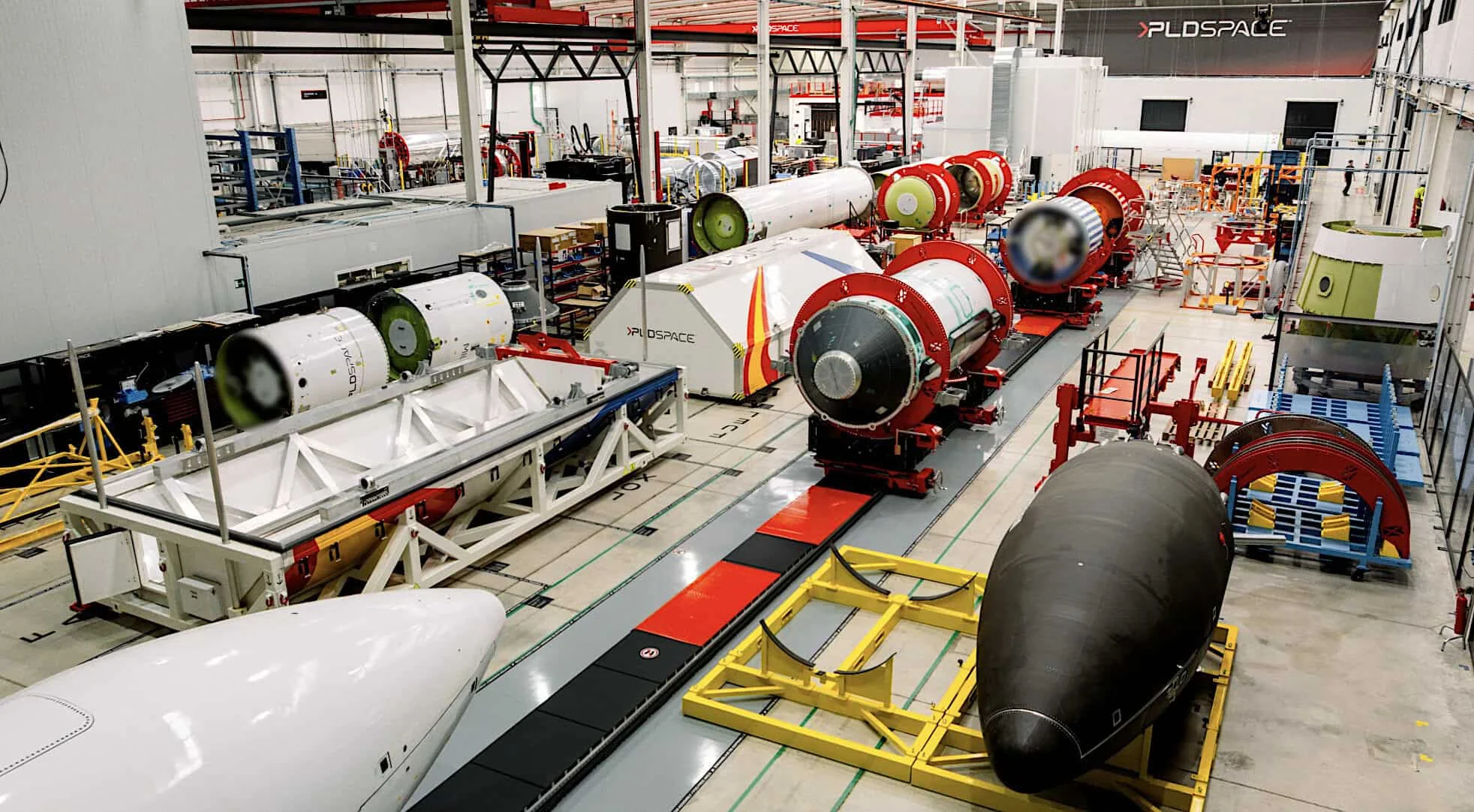
— 158.9 million euros to PLD Space, which has said it’s determined to conduct an orbital flight this year from a new pad at Europe’s Guiana Space Center spaceport on the northeast coast of South America.
PLD has obtained special dispensation from the French space agency, CNES, which is managing construction of the new facility to host multiple launcher startups, to proceed with flight before the facility is fully completed. PLD has said its obligations to its customers call for launches to start this year.
PLD has laid out plans to evolve its Miura 5 vehicle into a larger Miura Next rocket. The company has not announced an inaugural launch date.
— 186.9 million euros for Rocket Factory Augsburg (RFA), whose inaugural mission is scheduled to occur at Scotland’s SaxaVord Spaceport.
RFA is majority-owned by OHB Group, a major contractor for the Ariane 6 rocket and also working on a German spaceport.
OHB Chief Executive Marco Fuchs said of the ELC award:
“Within the OHB Group, we already provide the largest industrial work share for Europe’s current heavy-lift launcher, Ariane 6, and we are developing launch infrastructure both on land and through mobile offshore launch platforms,” Fuchs said. RFA work under the ELC award “include the further development of the RFA One Block 2 launch vehicle, expansion of the required ground infrastructure, and preparation for scalable serial production.”
RFA appeared to be nearing an inaugural flight in July when it discovered a problem in the vehicle’s pressure system and de-stacked the rocket to conduct further testing.
No launch date has been announced, but Fuchs told investors in August that he remained hopeful for a new attempt before the end of this year.
Originally published by Space Intel Report. Read the original article here.