



Eutelsat: Starlink/Starshield Controversy in Ukraine Could Not Happen with OneWeb; Company Wants to Enter D2D Market

Originally published by Space Intel Report. Read the original article here.
LA PLATA, Maryland — Eutelsat Chief Executive Jean-François Fallacher said the confusion in Washington over whether Elon Musk decided, on his own, to reduce SpaceX’s Starshield performance in Ukraine — a decision since reversed — could not happen with Eutelsat’s OneWeb constellation.
Seizing an issue that Eutelsat hopes will ultimately result in not only European governments but also nations in Latin America, Asia and elsewhere to become OneWeb customers, Fallacher said Eutelsat’s corporate governance model limits what its CEO can do solo.
“We have a board of directors that makes decisions of importance on strategy,” Fallacher said Oct. 23 on BFM Business radio. “If one day we decided to cut service to a country, it would not be just the CEO. The board of directors would decide.
“We have two governments, France and Britain, that sit on our board, and we have Bharti of India as well. Regardless of any decision by a US or Chinese company to stop service in Europe, we have a service that continues.”
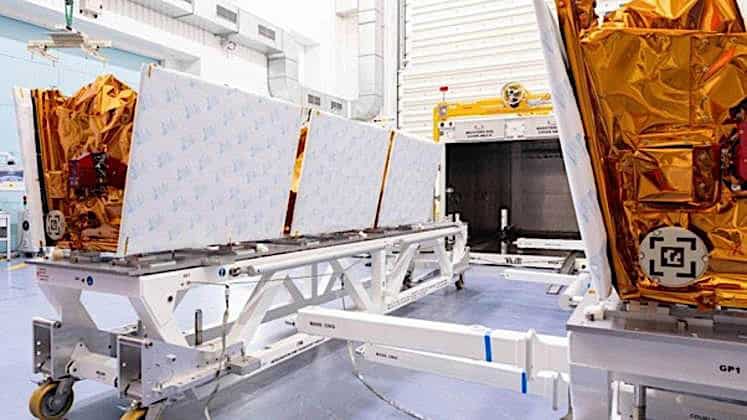
Depending on the use, Eutelsat’s current Gen 1 OneWeb constellation of 640 satellites in low Earth orbit cannot match Starlink in performance. But Eutelsat has 440 Gen 1 continuity satellites on order with Airbus Defence and Space, and another 229 Gen 1.5 models coming after that, also from Airbus.
Fallacher said Ukraine is one of the most-active users of OneWeb now, “and when you read the news of recent days, we think that will continue.”
The coming OneWeb satellites, some of them including hosted payloads for the French Defense Ministry, will carry the service to around 2032 or beyond, which is long enough to hand over commercial customers to the future Iris2 multi-orbit constellation.
Eutelsat is investing around 3 billion euros ($3.36 billion) in Iris2, which Fallacher said would enable OneWeb to double or triple its capacity. The entire Iris2 project’s capital cost is about 15.6 billion euros, 60% of it from the European Commission and the rest from the SpaceRise consortium of Eutelsat, SES and Hispasat.
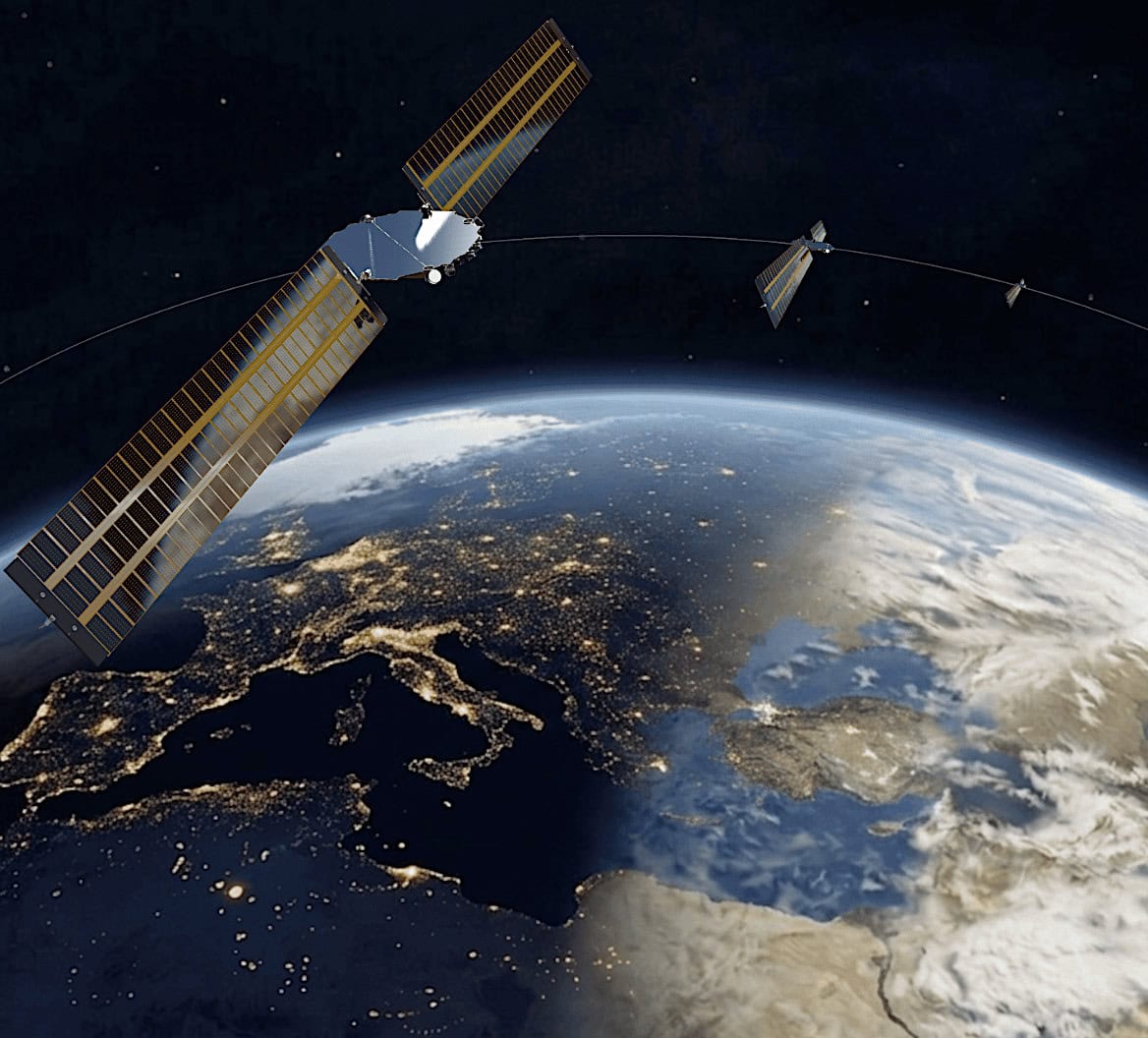
The governments of Poland and Spain recently announced they would be making their own, separate investments in Iris2 with satellites in both the Iris2 LEO layer at 1,200 km in altitude — the same as OneWeb — and the MEO layer at 8,000 kilometers, the same as SES’s O3b mPower constellation.
Discussions under way with Poland, Spain, others about future Iris2 investment
Fallacher said the SpaceRise consortium is in discussions with Poland and other nations seeking a greater presence in Iris2 “about what these contributions might be used for.”
“It could be for an increase in the number of satellites. Right now we have 264 Iris2 satellites for dual use, and 66 for military-only use. Maybe we could use more of these. Some satellites could be in inclined orbit to cover more population centers, and others in polar orbit to extend Arctic coverage.”
Fallacher said discussions are under way with about 10 European nations, including Britain, about an enhanced role in Iris2.
SpaceRise and the Commission elected to choose Aerospacelab of Belgium over Airbus to build the main LEO shell despite that company’s limited heritage, especially in serial production.
Fallacher acknowledged the risk but said it was mitigated by the fact that Thales Alenia Space of France and Italy would be building the dual-use payloads for the Aerospacelab satellites as well as the 66 military-Ka-band only satellites from Airbus.
“We issued an RFP and it ended with the choice of Aerospacelab,” Fallacher said. “This is not a completely new company, it has several hundred employees and generates more than 100 million euros in revenue.”
Aerospacelab financial reports to Belgian authorities show 2025 revenue of 14.6 million euros.
Aerospacelab bid for 264 Iris2 LEO satellites was less costly, with a more aggressive design
He said the Aerospacelab offer was not only less expensive than Airbus’s but also “more aggressive, more advanced,” Fallacher said.
“So yes, it’s a risk but we need to take risks if we hope to be at the level of what we see from our American friends and from China. And there was the economic aspect that weighed in here. We want to sell our OneWeb services at the market price all over the world.”
Eutelsat sees a future D2D play as a constellation operator
He said Eutelsat expects to enter the direct-to-device market, which would be a separate constellation from OneWeb, by offering “a European sovereign constellation.” He said the recent announcement that European telcos Orange, Vodafone, Deutsche Telekom and Telefonica are considering a joint bid for the European S-band spectrum coming up for license renewal in 2027 could be an opportunity for Eutelsat as a constellation operator.
Urging an increase in Ariane 6 launch rate
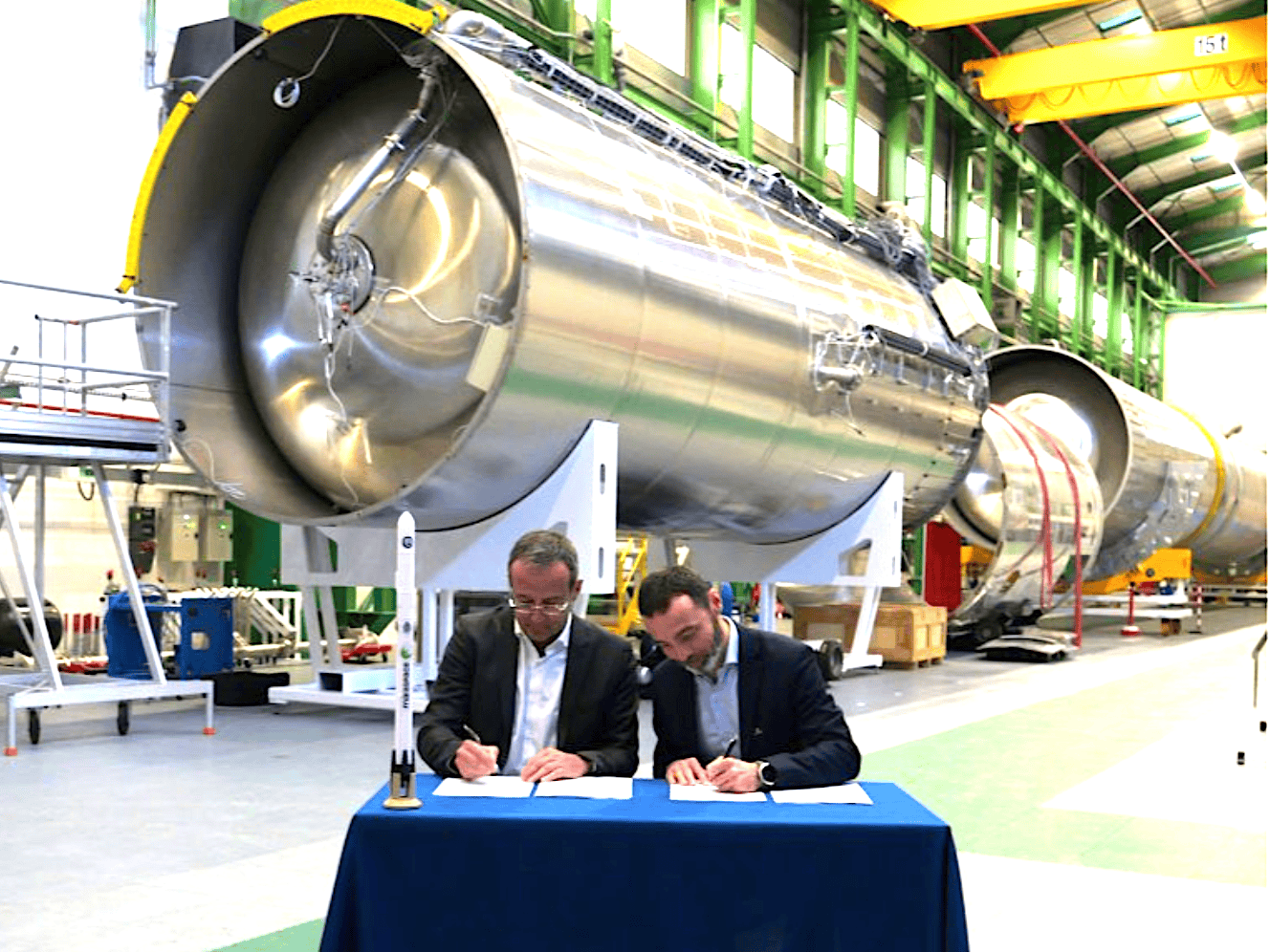
Eutelsat is pressuring the builders of Europe’s Ariane 6 rocket to increase the production rate, despite the high cost of doing so. “I think it’s critical. We are pushing for Ariane increases in flight frequency,” he said. Eutelsat has signed a multi-launch agreement with Maia Space, a subsidiary of Ariane 6 prime contractor ArianeGroup, and is also in discussions with other European launcher startups about future launches.
Eutelsat has a OneWeb launch aboard a SpaceX Falcon 9 coming up. For the Iris2 satellites, he said launches should start in 2029 and “no surprise, these will be with Ariane.”
Originally published by Space Intel Report. Read the original article here.