



French-German Ministers’ Meeting Lauds Iris2 As ‘Europe’s Digital Backbone,’ Want 2-GHz Spectrum Reserved for It

Originally published by Space Intel Report. Read the original article here.
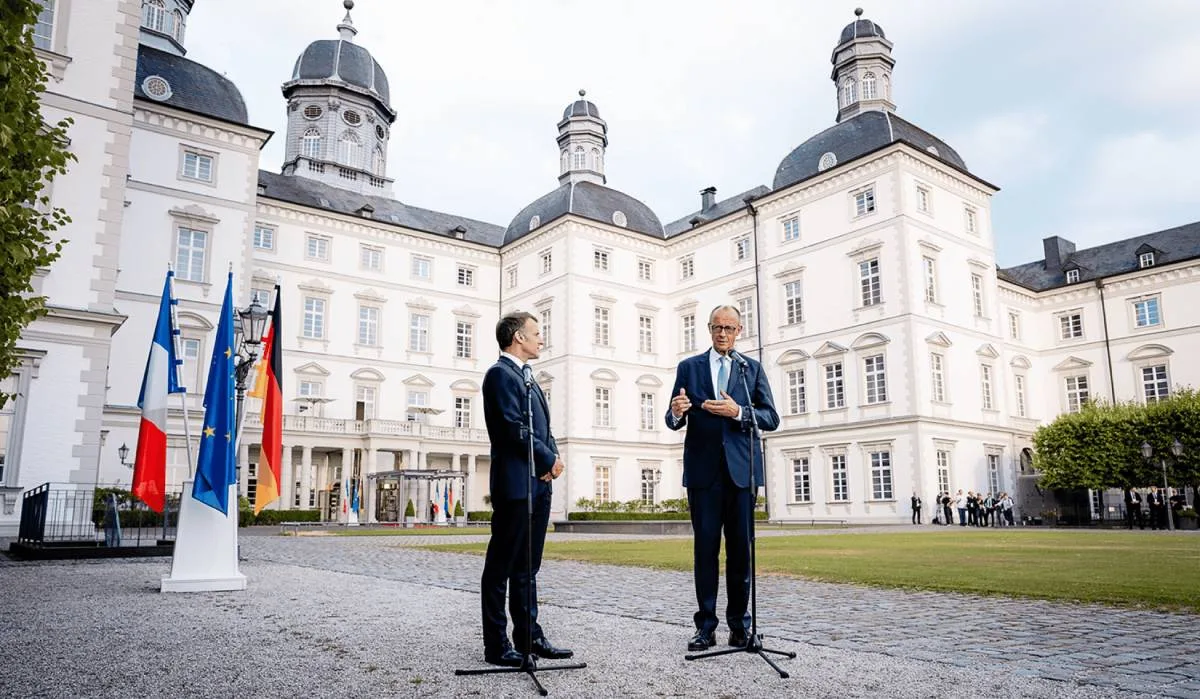
LA PLATA, Maryland — The German government, whose skepticism about Europe’s Iris2 multi-orbit secure connectivity project is well-known and long-standing, accepted a remarkably pro-Iris2 statement following the July 17 Franco-German Council of Ministers in Brühl, Germany.
Without ceding any ground on plans for its own, all-military version of Iris2, Germany agreed to post-council language that positioned Iris2 as indispensable for Europe.
“We recognize the crucial role of Iris2 for a resilient, combined and robust European space infrastructure,” the governments’ joint statement said.
“It is the first step towards a European system of systems, with Iris2 as its data backbone. As a result, both countries agree on the following principles for Iris2:
- “Timely provision of services
- “Consideration of use cases (bandwidth, latency, security and quality of service) including the identification of distinct user groups with diverse and varying demands
- “Commercial approach to stimulate private investments and competition
- “Public-private partnerships as core of the program in order to leverage the financial capacity and innovation for the public sector and, at the same time, keep public markets open for commercial players.”
The two governments said they had created a high-level working group on space to pursue these principles.
Germany’s multibillion-euro SatcomBw-4 constellation, for which contracts are expected be awarded this year, has been viewed as a threat to Iris2. German military officials have said their constellation would be interoperable with Iris2. The council said interoperability will be studied.
“France and Germany will actively explore interoperability opportunities i.a. between Iris2, promoted by France, and Germany’s future national constellation to enable federated space systems while protecting national sovereignty and services. They will continue and intensify their cooperation on next-generation space-based reconnaissance systems,” the post-Council document said.
The two governments agreed that the European Commission’s scheduled awarding satellite spectrum in the 2-GHz frequency range in 2027 should reserve a portion for Iris2.
“Taking into consideration that the MSS 2-GHz band has a very strategic importance, Germany and France agree that the selection procedure shall offer a wholesale access under objectively justified, non-discriminatory, proportionate and transparent conditions.
“Securing for Iris2 an adequate portion of the 2-GHz radio spectrum in Europe for D2D [direct to device] services is essential and should be made clear in the proposed regulation.”
The two governments agreed to “intensify efforts to make use of Ariane 6 and other European launchers for the deployment of military satellites,” but did not cite any effort to coordinate advance orders of Ariane 6 rockets so that they would be available when Iris2 and SatcomBw-4 are prepared to launch. Both constellations are seeking to begin deployment in 2029.
There is considerable doubt about whether Ariane 6 will have spare launchers then, even if it has set aside capacity for government missions. Parent company ArianeGroup has said it cannot, on its own, commit to building Ariane 6s without a customer order.
The German Bundeswehr has stressed that SatcomBw-4 cannot be delayed. Its willingness to delay the project’s deployment to wait for Ariane 6 capacity is uncertain.
The statement said France and Germany agree on the primacy of the International Telecommunication Union (ITU) as arbiter of radio spectrum and orbital slots.
“France and Germany will support the key role of the ITU in the frame of the International Space Summit,” scheduled for Sept. 9-10 in Paris, they said.
Originally published by Space Intel Report. Read the original article here.