


How Solar Storms Are Stress-Testing LEO Fleet Architectures

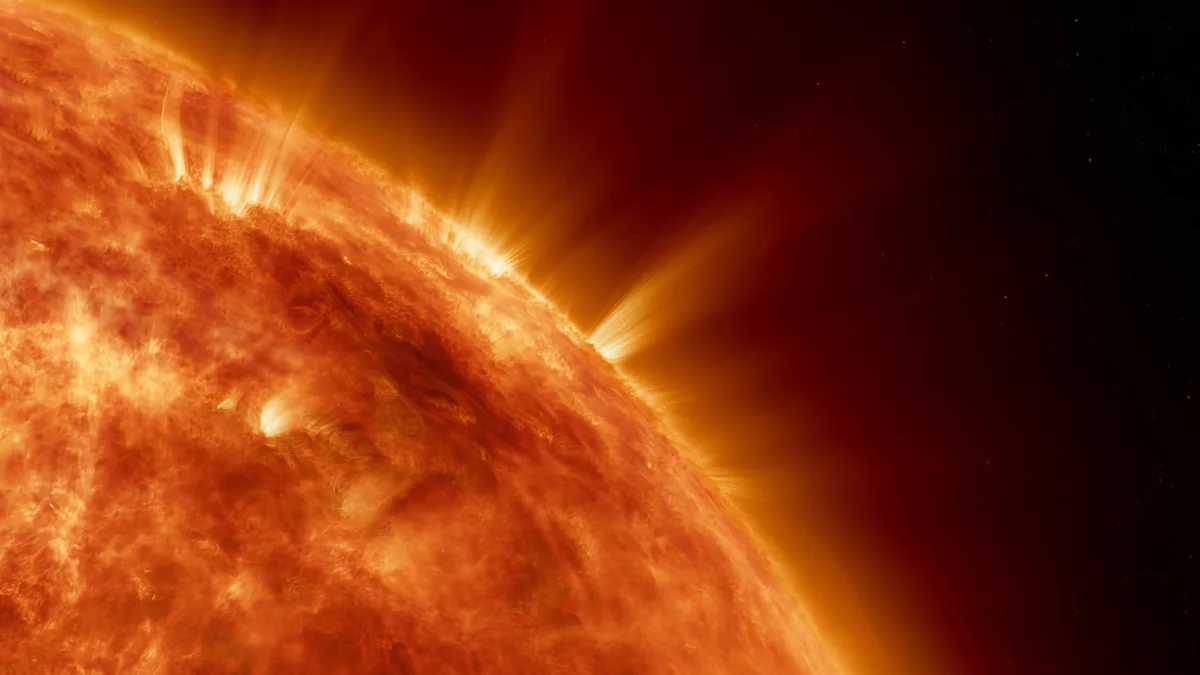
Rising solar-weather volatility is exposing the limits of current thermosphere and drag-prediction models, creating major operational, autonomy and space traffic challenges for large LEO constellations. As a result, operators, insurers and governments are being pushed toward more resilient architectures—better data sharing, multi-orbit designs, hardened electronics and improved space weather forecasting—to keep modern space infrastructure reliable.
Constellations talked to Lionel Birée, aerospace research engineer and associate researcher at the Paris Observatory and SSA specialist at space consultancy Elios-Space, about solar weather events and what they mean for future constellation designs.
Q: When you look across a full megaconstellation, how wide is the drag spread, and how unevenly do satellite lifetimes shift across different altitude bands?
A: The drag experienced by a megaconstellation is not uniformly distributed, because atmospheric density varies significantly with altitude. Data show that density models behave consistently at low altitude (around 270 km) but become less reliable and more dispersed at higher altitudes. Thus, satellites located in the lower layers experience much stronger drag than those positioned in the upper layers. The distribution of drag also depends on the composition and temperature of the thermosphere, which themselves vary with altitude. Above roughly 500 km, helium becomes a significant component of atmospheric density, altering the drag experienced by satellites at these altitudes. In addition, drag coefficients are not constant. For example, at around 510 km, the measured coefficient is close to 2.425, higher than the standard value of 2.2, due to geomagnetic and thermal variations. These variations show that drag increases and decreases non-uniformly within a megaconstellation depending on altitude.
Q: When forecast errors start driving early re-entries, at what point do they create real uncontrolled-re-entry risks for dense constellations—and what happens as a result?
A: Solar maxima increase thermospheric density, which strengthens atmospheric drag and accelerates the loss of altitude of satellites. Forecast uncertainty becomes significantly problematic when solar or geomagnetic activity produces enough atmospheric expansion to cause orbital decay faster than what the models anticipate. Data shows that during geomagnetic storms and periods of strong solar activity, satellites reenter sooner than expected because of the increased drag.
In dense constellations, this results in an acceleration of re-entry rates that can lead to the simultaneous loss of many satellites during episodes of strong solar activity, as well as an increase in operational risks linked to the rise in atmospheric density, which reduces the ability of satellites to maintain altitude, particularly for those with limited propulsion. This is compounded by an increased risk of collisions, as satellites descend at different rates, disrupting their orbital distribution and complicating space traffic management.
Q: As drag rises, how does it reshape the propulsion budget for large LEO fleets?
A: The increase in drag in low Earth orbit directly raises the propulsion consumption of large fleets, because satellites must perform more frequent station-keeping maneuvers to compensate for accelerated orbital decay. The direct consequence for dense constellations is an acceleration of replacement cycles, since satellites see their lifetime decrease under the combined effect of drag and episodes of strong solar activity. Analyses of hundreds of satellites show that reentries occur earlier as geomagnetic activity increases, with satellites experiencing the fastest orbital decay rates when drag intensifies.
The acceleration of orbital decay caused by increased drag therefore worsens this constraint, potentially reducing the planned five-year interval between satellite generations. In extreme cases, the renewal cycle may become insufficient to maintain the operational capacity of a constellation if losses or orbital decreases occur earlier than expected. Thus, increased drag can significantly raise the propulsion budget, accelerate replacement rates, and jeopardize the viability of constellations designed with five-year cycles, because satellites may no longer reach their expected lifetime before scheduled renewal.
Q: To what degree are current space traffic management systems designed to handle storm-scale orbit changes?
A: Surveillance networks and computational infrastructures must process an increasing volume of orbital updates. The rapid growth of the LEO population in recent years has already generated a sharp rise in conjunction messages sent to operators, illustrating the mounting difficulty of maintaining reliable tracking when orbits change quickly. Solar eruptions further aggravate this situation, as they trigger orbital changes that are larger and more frequent than those encountered under routine conditions. Current systems can manage such variations, but they are not fully designed to absorb without performance loss orbital fluctuations as abrupt as those produced by the strongest geomagnetic storms, which require more frequent updates, more accurate density modeling, and strengthened coordination among operators.
Q: Many constellations rely on automated collision-avoidance logic. How might sudden density spikes trigger cascades of maneuvers?
A: Automated collision-avoidance systems rely on orbit predictions that are sufficiently stable to trigger maneuvers only when clearly defined risk thresholds are exceeded. During sudden peaks in atmospheric density caused by intense geomagnetic activity, satellites experience a rapid increase in drag, which accelerates their orbital decay and alters their parameters more quickly than standard models can anticipate.
Q: As drag variability grows, how might mixed-orbit architectures become more attractive?
A: The increase in drag variability in low Earth orbit, amplified during periods of strong solar activity, makes LEO altitudes more unstable because satellites experience faster orbital degradation than what standard models predict. This instability can make mixed-orbit architectures more attractive, combining low orbit for reduced latency with higher orbits, such as medium Earth orbit (MEO) or geostationary orbit (GEO), to benefit from greater environmental stability. Observations show that during periods of intense solar activity, the rise in atmospheric density alters the orbital parameters of LEO satellites much more rapidly than expected, complicating altitude maintenance and reducing operational longevity. By contrast, MEO and GEO are not affected by atmospheric-density variations driven by space weather and maintain higher dynamical stability, which can help increase overall system resilience when integrated into a mixed architecture. Satellites in these higher orbits also benefit from longer lifetimes and risk profiles that are historically easier to model, due to lower exposure to drag and reduced orbital variability.
However, even if MEO and GEO are not sensitive to atmospheric-density effects, they remain exposed to solar-activity-driven disturbances through changes in the radiation belts. Solar activity directly affects the dynamics and intensity of trapped particles, requiring satellites operating at these altitudes to rely on suitably adapted architectures to ensure adequate protection, particularly against increased energetic-particle fluxes that can shorten electronic lifetimes or trigger anomalies. This constraint adds to the need for reinforced design and appropriate orbit selection based on mission profiles.
Q: As governments rely more on commercial LEO constellations for defense and civil resilience, how does increasing atmospheric unpredictability affect assumptions about orbital sovereignty?
A: The growing variability of the atmosphere in low Earth orbit, strongly influenced by geomagnetic storms and the intensity of solar activity, directly undermines assumptions about orbital sovereignty.
For states relying on commercial constellations for defense or civil-resilience purposes, atmospheric dynamics challenge their ability to ensure long-term control and continuous availability of space assets—two fundamental pillars of space sovereignty. Orbital diversity influences this planning by providing a means to reduce exclusive dependence on low Earth orbit, which is particularly vulnerable to fluctuations in atmospheric density. Higher orbits, such as MEO and GEO, offer superior environmental stability because they do not undergo the rapid drag variations that affect LEO satellites. This stability enables a strategic posture in which certain critical functions remain protected from atmospheric disturbances, while low orbit continues to be leveraged for its operational advantages.
Combining multiple orbital altitudes therefore helps limit the systemic impact of space-weather phenomena on national capabilities by distributing risks across different dynamical environments. This reasoning echoes growing concerns within the sector, as stakeholders observe both a rapid increase in LEO traffic and heightened sensitivity of infrastructures to solar activity—factors that reinforce the relevance of diversified spatial architectures for national security.
Q: How might extreme solar weather reshape edge vs. ground processing?
A: Geomagnetic storms (in addition to solar flares) can disrupt, damage or even destroy satellite electronics, affect payloads, trigger anomalies and reduce the reliability of downlink capabilities. Recent analyses show that energetic-particle fluxes and radiation disturbances are among the most critical factors affecting the integrity of electronic systems in orbit, and that they can cause transient or permanent failures in instruments, processors, and communication systems. As space architectures evolve toward increased onboard processing, inter-satellite links and autonomy driven by algorithmic systems, vulnerability to extreme radiation events increases, because a growing share of operations depends on software and hardware infrastructures directly exposed to variations in the space environment.
This evolution shifts the balance between edge computing in space and centralized ground-based processing, because solar storms can impair satellites’ ability to execute critical operations locally if components experience electronic anomalies or logical interruptions. Increased particle fluxes associated with solar events may force operators to temporarily reduce onboard computational load or switch to degraded modes, thereby increasing dependence on the ground precisely when downlink communications become more unstable.
Q: How resilient are current cloud-supported satellite-processing models that rely on regionally concentrated ground infrastructure during major solar storms?
A: The migration of satellite-data processing and storage to the cloud depends on the resilience of ground infrastructures to strong solar storms, as these events can disrupt power grids, communication systems, and the electronic architectures that support cloud services. The most intense geomagnetic storms can cause damage across large areas, leading to failures that may affect essential data services. This fragility extends to the cloud model, which relies on geographically concentrated data centers powered and interconnected by infrastructures vulnerable to ground-induced currents and magnetic-field fluctuations.
The concentration risk created by a small number of dominant cloud regions should therefore be seen as a systemic vulnerability. Solar storms can cause simultaneous disruptions across large geographical areas, challenging the resilience of a model built on a limited number of critical hubs. Digital infrastructures depending heavily on these regions could experience coordinated outages if power grids or communication links in cloud centers are affected. Industries must recognize that the same physical phenomena capable of impacting satellites can also affect the terrestrial nodes supporting data storage and processing—and that excessive concentration of these capabilities in just a few regions increases overall vulnerability during a major solar storm.
Q: If solar weather becomes a defining constraint, how might it reshape the geography of space activity?
A: If solar weather becomes a major environmental constraint for low Earth orbit infrastructure, it could significantly reshape the long-term distribution of space activities. Studies conducted between 2023 and 2025 show that commercial satellites operating in low Earth orbit lost altitude more quickly than standard models predicted, forcing operators to revise their forecasts and adapt operational procedures. These discrepancies, amplified by geomagnetic activity, suggest that exclusive reliance on low Earth orbit could become more costly and more difficult to sustain for dense constellations—especially when atmospheric-density variations are poorly anticipated.
In such a context, operators may be pushed to rebalance their infrastructure toward more stable orbital regimes, such as medium Earth orbit or geostationary orbit, which do not undergo the rapid fluctuations induced by atmospheric drag and whose environments are historically more predictable. Higher orbits provide more stable conditions for long-duration operations because they are not affected by atmospheric density, enabling more robust strategic planning. This redistribution could support mixed or segmented architectures, allocating critical functions across multiple altitudes to limit the systemic impact of an extreme solar-weather episode.
If the LEO environment becomes increasingly volatile, operators may also consider alternative architectures, such as more autonomous platforms, hybrid orbital systems combining multiple altitudes or even off-planet infrastructures adapted to the variability of cislunar environments.
Consequently, if solar weather were to establish itself as a dominant constraint, it could gradually reshape the distribution of space infrastructure by encouraging operators to favor less exposed orbits, design multi-altitude architectures and explore infrastructure solutions located outside low Earth orbit to ensure long-term resilience.