



The Decision Layer: Standardization Beyond the Prototype
A Conversation at the Intersection of Technology and Strategy

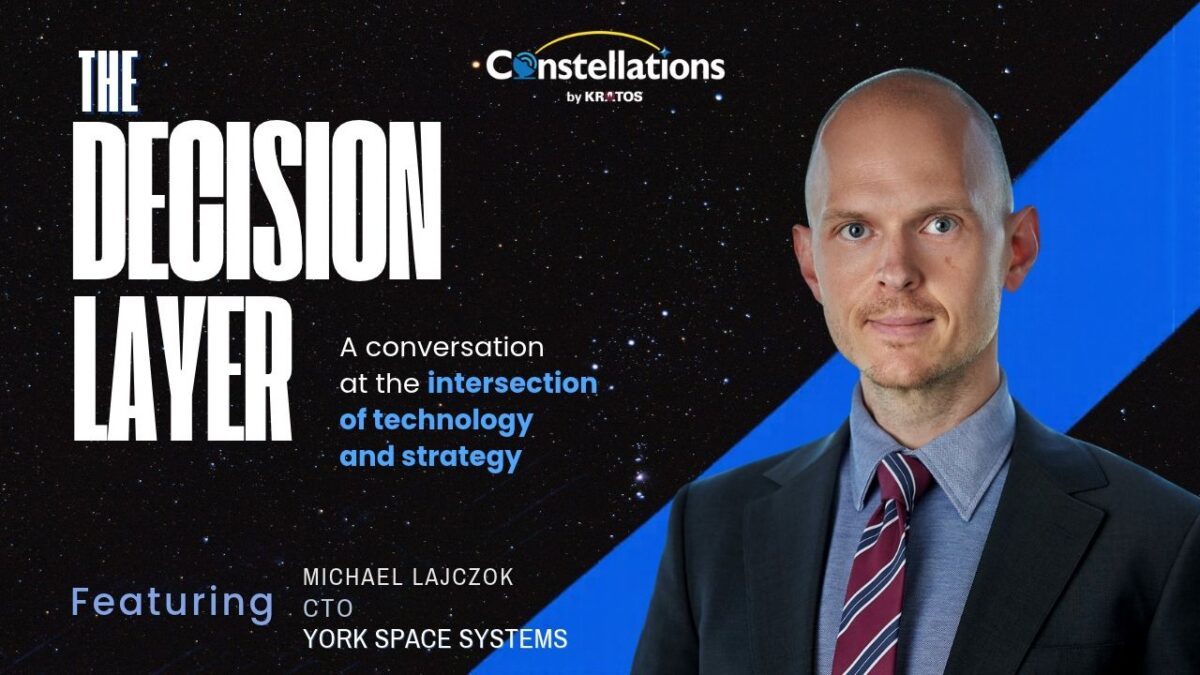
“For a long time, the assumption was that lower cost meant accepting lower quality. Standardization challenges that assumption.”
—Michael Lajczok, CTO, York Space Systems
The Decision Layer explores how senior technology leaders approach the responsibilities that come with executive-level oversight and how they frame the decisions that move a space organization forward. With each installment, we’re continuing a dialogue that brings these innovation-shaping perspectives into focus.
In this installment, we speak with Michael Lajczok, York Space Systems’ chief technology officer, about the engineering philosophies driving the industry’s shift toward more standardized spacecraft.
Michael Lajczok leads product architecture, development and lifecycle evolution at York Space Systems, focusing on standardization, common component use and scalable manufacturing. With two decades of engineering experience, Lajczok oversees spacecraft product configuration baselines and develops technology roadmaps to drive product improvements.
Prior to joining York, he served as a subsystem lead engineer at SAIC and Northrop Grumman, leading efforts in spacecraft servicing, spaceflight hardware ruggedization, responsive space systems and tactical propulsion. Lajczok holds a Master’s degree in Mechanical Engineering from Washington University in St. Louis, Missouri.
Q. You stepped into the CTO role during the critical development window of the S-CLASS spacecraft. From that experience, what should the industry understand about how engineering philosophy must change when the goal shifts from one-off spacecraft to a standardized, repeatable platform?
A. Making something work in space has not magically become easier or cheaper. What has changed is our ability to standardize products and build them repeatedly, bringing down cost. That repetition allows suppliers to improve quality, reduce manufacturing variability and produce at greater scale. It also allows us to build more autonomy into operations, so smaller teams can manage larger fleets.
For a long time, the assumption was that lower cost meant accepting lower quality. Standardization challenges that assumption. When you build and operate the same design repeatedly, you learn where it performs well, where it needs improvement and how to make the next vehicle more reliable. In fact, standardized platforms can deliver better reliability than higher-cost bespoke systems.
The distinction is how you achieve those savings. Some new entrants are trying to reduce costs by cutting processes or using cheaper components, which can introduce risk rather than eliminate cost. At York, we focus on quality components, proven designs and established production processes, while limiting bespoke engineering. That combination allows us to deliver reliable spacecraft at a lower cost and greater scale.
Q. Having spent your early career in NASA thermal systems engineering – where programs were highly technical, custom-built, and risk-intolerant – what lessons from that environment still guide your thinking today as you set technology roadmaps for a rapidly scaling commercial space company, and which elements of that legacy do you believe the industry must rethink if it hopes to move toward truly scalable, standardized spacecraft production?
A. My time as a NASA contractor shaped how I think about technology development and risk. You learn to ask two questions about any potential failure: How likely is it, and what happens if it occurs? That risk-based decision-making discipline remains essential, regardless of how quickly you are moving or how many spacecraft you are building. I have seen it produce highly capable, technically sophisticated systems. I have also seen the same processes used to reinvent commercially available solutions, resulting in products that are more expensive, less reliable and sometimes lower-performing.
At York, we look closely at Technology Readiness Level (TRL) and Manufacturing Readiness Level (MRL). Put simply: Has the technology been built and demonstrated before, and how mature is our ability to produce it consistently at scale? Both matter. A successful prototype does not automatically translate into a reliable production line.
Through product standardization, we have increased both the technology readiness and manufacturing readiness of York’s spacecraft platforms. We have repeatedly built, flown, and operated the same designs, giving us a strong understanding of their performance and production requirements. That experience allows us to deliver high-performance spacecraft while reducing cost and risk for our customers. Aviation illustrates the value of this approach: standardized designs, repeatable manufacturing and accumulated operational experience have made flying both widely accessible and remarkably safe.
Q. As the small-satellite market grows more crowded, staying ahead requires choosing the right architectural bets. From your perspective, which technological or structural choices are truly essential for achieving end-to-end standardization, and where do you see the industry most often misjudging what can – and cannot – be modularized when evaluating those bets?
A. Our industry is defined by our access to space. The cost and cadence of launch should drive fundamental architectural decisions, including spacecraft size, cost, and acceptable risk. A single satellite design cannot perform every mission.
Where I see the industry sometimes misjudging standardization is in expecting payloads to become standardized over time. Payloads exist to provide novel capabilities, and those capabilities will continue to bring new interface requirements. A standard spacecraft platform needs to be readily tailorable to those changing requirements.
The engineering challenge is to accommodate payload differences while preserving the core design and production processes that make the platform repeatable. If accommodating a new payload requires extensive redesign of the spacecraft, you have lost much of the value of standardization. But expecting every payload to conform to rigid interfaces also limits the market you can serve. Getting that balance right is essential.
Q. Moving from VP of Mission Solutions to CTO meant shifting from customer-driven mission design to shaping long-range technology standards. How did that transition change the way you think about innovation, feasibility and speed – and what guidance would you offer the industry on balancing bespoke mission needs with the discipline required to maintain a standardized product line?
A. A product is only relevant if it solves a customer’s problem at the right price. I learned that in mission solutions, and it continues to guide my thinking as CTO.
We actively assess gaps between our products’ performance and customer requirements. When we see a strong enough demand signal in an area where we have a capability gap, we typically invest in that technology ahead of time to serve that new market or customer need. That gives us greater control over development and allows us to manage the impact on our standard product line.
After we fly an improved product, we learn from its performance and use that experience to update what we consider standard. That is how a product line evolves while retaining the benefits of repeatability.
A common mistake I see in our industry is trying to standardize something that has not yet been built and flown. You need that experience to understand what works, what is repeatable, and where the design needs to improve. Customer demand tells you where to invest; production and flight experience tell you what is ready to become standard.
Q. Looking ten years ahead, what aspects of spacecraft engineering do you believe will see the biggest shift toward standardization, and how should the industry prepare without compromising reliability or manufacturability today?
A. In a word, software.
The last decade has largely focused on maturing production and supply chains to deliver proliferated constellations to orbit. As we solve more of the challenges associated with mass production and launch satellites more frequently, the focus is shifting toward evolving their capabilities after launch.
The traditional model was to meet contractual requirements prior to launch and then maintain the vehicle’s operation, making changes primarily in response to anomalies. With more computing power on each spacecraft, we can take a software-defined mission approach, finding new ways to use systems already on orbit that were not envisioned before launch.
To do that responsibly, spacecraft need an architecture that protects safety-critical systems while allowing rapid software updates. We also need greater standardization of operating systems and constellation networking approaches to support interoperability across networks and greater autonomy in operations and data management.
The ability to keep improving a spacecraft after launch will become an increasingly important part of its value over the life of the mission.
Q. Commercial space timelines prioritize iteration, but standardization requires long-term architectural stability. What guides you when deciding which challenges are worth taking on, and how do you reconcile your engineer’s instinct for precision with market demands for rapid iteration?
A. Airplanes always need wings, and cars always need tires, even as their electronics and software systems change rapidly. With the mass-produced products we use every day, we understand that some features evolve slowly while others need frequent upgrades. We apply the same thinking to spacecraft.
Car tires perform much better than they did 50 years ago, but consumers rarely see a fundamental change in tire technology from one model year to the next. The vehicle’s technology package, by comparison, can change substantially.
Some core and safety-critical spacecraft components have life cycles on the order of a decade. Other performance-driven components may need upgrades every two to five years to meet evolving market requirements. The goal is to accommodate those upgrades without repeatedly disrupting the core design or production line.
All prospective changes to our core products are assessed by our product control board to ensure the engineering case and market need align. That means evaluating both the value of an improvement and its implications for qualification, manufacturing and operations.
Q. When you look at the industry’s shift toward integrated, repeatable spacecraft platforms, what are the concerns that stay with you on a personal level – and conversely, what gives you the strongest confidence that this model is the right direction for the sector?
A. Before something is achieved the first time, it can feel impossible. You do it once, and it is still difficult. You do it many times, and it becomes easy. This is a common thread across most human endeavors, and one that I have personally experienced in developing York’s spacecraft platforms.
This is still a young industry with tremendous room for growth.