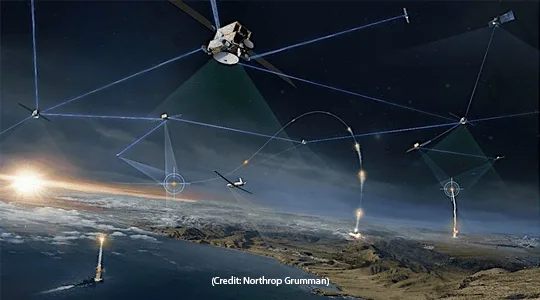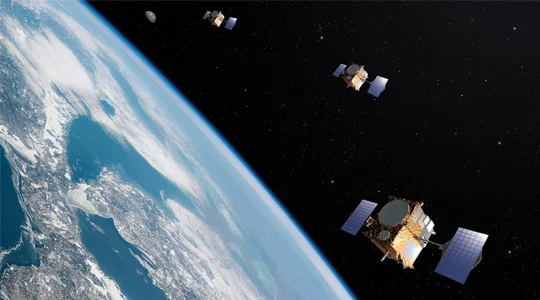





Space is a Network.
Constellations is Your Connection.

The Sept. 2 launch of 13 U.S. Space Development Agency (SDA) satellites leaves brings to 23 the number of Tranche 0 Transport and Tracking spacecraft in orbit. All these missile detection and tracking satellites are equipped with optical communications terminals (OCTs), which SDA has repeatedly said is a key development goal for its Proliferated Warfare Space Architecture.

Space and airborne laser communications terminal (LCT) builder Mynaric AG reported a backlog of 348 units as of April 27, up from the backlog of 256 terminals as of Dec. 31. Germany-based Mynaric is one of several companies under contract to the U.S. Space Development Agency (SDA) and the U.S. Defense Advanced Research Projects Agency (DARPA) to test lasers on relatively small satellites in low Earth orbit.

The year 2022 was the first time in history that the private sector launched more tonnage into space than the world’s governments, and the single most important cause is SpaceX’s Starlink broadband constellation. “The growth in the [private sector] is 100% linked to the activity of Starlink, deploying an incredible amount of mass in recent years.”

The 2023 edition of the “Space Environment Report” published by the European Space Agency (ESA) shows a gradual adoption of practices including end-of-life disposal of satellites. But it also shows that far too many operators in low Earth orbit — below 2,000 kilometers — are doing either nothing or too little to remove their spacecraft from these increasingly crowded orbital highways.

Indonesia has perhaps the world’s most extensive satellite broadband deployment program and is finding out that even before it’s deployed, it’s not enough. Indonesia’s extensive deployment, with two high-throughput satellites launching this year, goes as far as any nation in pushing connectivity into unserved regions.