Space is a Network.
Constellations is Your Connection.

Eutelsat unifies GEO and LEO to deliver resilient network solutions for government and commercial users. The rebrand reflects a shift from wholesale capacity to end-to-end, mission-focused services that combine constellations, terminals and third-party tech for secure, redundant connectivity. Expect continued investment in multi-orbit resilience, PNT alternatives and new product rollouts that support complex operational environments.

Market Competition & Strategy

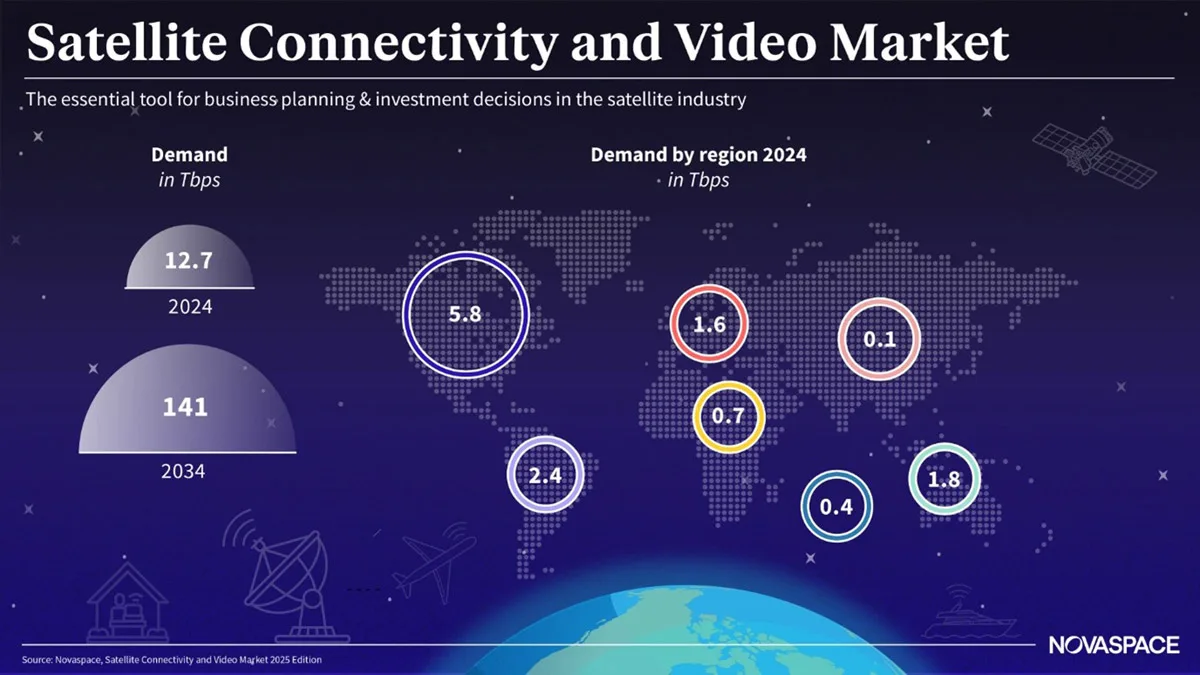
Satcom Market Shifting to Data Applications

Data applications are projected to rise from 21% to 55% of service revenues by 2034, nearly tripling to $67B and driving total market expansion to $122B. This shift will push capacity demand from 12.7 Tbps to 141 Tbps, reshaping revenue models and opening new opportunities across commercial, government, and consumer segments.

Industry leaders say true smartphone-grade broadband from satellites is still years away and will arrive first in specific verticals rather than as an immediate consumer replacement. Mobile network operators may be using D2D deployments as market probes, leaving business models and who ultimately pays for the service unresolved.

By detecting and discarding cloudy pixels before transmission, this technology saves crucial bandwidth and can slash downlink costs by up to $150,000 a year. This dynamic targeting allows even power-constrained CubeSats to operate more autonomously, ensuring they focus solely on delivering the highest-value data back to Earth.

In a discussion at World Space Business Week, leading Earth observation market executives discussed their exposure to, and reliance on defense markets. While some were more confident than others, do the deep pockets and enduring demands of governments and militaries wed Earth observation to defense, and what does that mean for the developmental future of the technology?