



4 Takeaways: How VLEO Changes Spacecraft Behavior and Operations

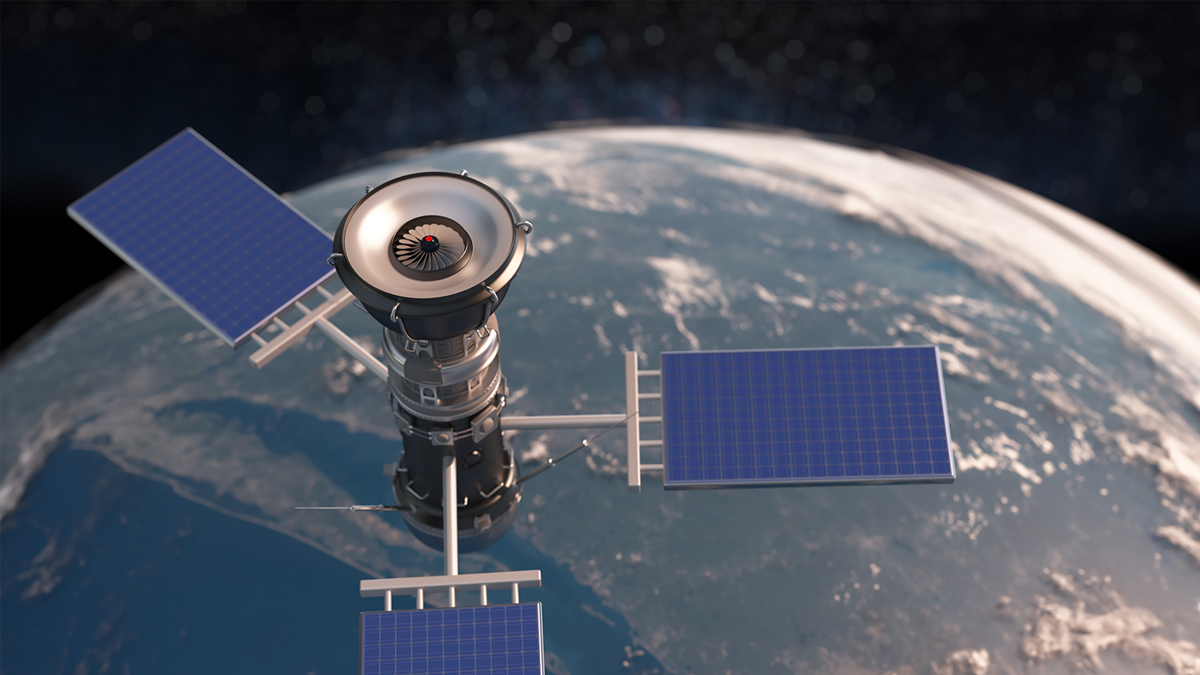
Flying in very low Earth orbit introduces distinct engineering, sensing and operational challenges that differ sharply from traditional LEO missions. At the SmallSat Conference, Orion Space Solutions CTO and VP of Strategy Chad Fish broke down what truly changes when spacecraft drop just a few dozen kilometers below typical LEO altitudes.
Read our top four takeaways from the conversation, or listen to the full episode.
Takeaway 1: The most fundamental question in VLEO is whether the spacecraft can stay in orbit at all.
When evaluating a VLEO mission concept, the first constraint is simple but uncompromising: orbital survival, according to Fish.
“The most important thing that you have to address today in VLEO is whether your spacecraft can stay aloft,” Fish said.
Atmospheric density rises exponentially as altitude decreases, and the solar cycle dramatically alters drag conditions over time. Before teams can optimize sensors, payloads or mission concepts, they must determine whether the spacecraft can remain aloft long enough to deliver value, he said.
Altitude selection also depends on the behavior of both neutral and charged particles. In VLEO, the neutral atmosphere and ionosphere change rapidly across relatively small altitude bands. This affects every aspect of spacecraft design – from propulsion needs to sensor performance – making it one of the most complex regions to operate in, Fish said.
Takeaway 2: Even small drops in altitude change spacecraft behavior in meaningful and unexpected ways.
Moving just 20–30 kilometers below common LEO altitudes can dramatically alter how a spacecraft behaves, Fish said. At higher LEO, geometry is forgiving – spacecraft can be boxy, rounded or oddly shaped without major consequences. In VLEO, shape becomes critical because drag increases sharply with broad surface area, he said.
“Think about something going through water, a river, an ocean. Something that’s pointed goes a lot better, a lot more smoothly than something that’s wide and broad. And so as you go down to lower altitudes, you need to take that into effect,” Fish said. “It’s pretty strange. You can have basically a refrigerator orbiting up around the space station, but as you get down 50, 60 kilometers, that thing’s not going to stay up there very long.”
Pointing and sensor calibration also become drag‑sensitive. In higher LEO, operators can rotate spacecraft freely. In VLEO, the same maneuver can create significant drag and disrupt orbital stability, limiting how instruments can be aimed and how often they can be calibrated, Fish said.
Thermal management is another challenge. High‑performance sensors generate substantial heat, but VLEO spacecraft move too quickly to leverage cold‑space “staring” techniques, Fish said. Missions must adopt new, more efficient ways to reject heat, he said.
Takeaway 3: Atmospheric density in VLEO is more variable – and more volatile – than most mid‑LEO designers anticipate.
For teams experienced in mid‑LEO, the dynamic behavior of VLEO’s atmosphere often comes as a surprise. Density is not only high – it is highly unpredictable. It can shift significantly over days or weeks depending on latitude, day‑night cycles and solar activity, Fish said.
A spacecraft may experience one drag profile one day and half – or even a quarter – of that density the next, Fish said.
This region behaves less like a static layer and more like an ocean full of waves and oscillations, Fish said. These atmospheric “waves” can span tens of kilometers, creating conditions far more dynamic than anything seen at typical LEO altitudes. This variability impacts orbit determination, propulsion strategies, duty cycling, sensor stability and constellation maintenance, he said.
Understanding – not just estimating – these fluctuations are essential for any VLEO mission, he said.
“One day, the density to certain altitude might be X, and it could be half of that or a fourth of that the next day. Most people don’t realize that. They understand that there’s an issue with density, but they don’t realize how variable that density is from day to day,” Fish said.
Takeaway 4: VLEO opens new commercial opportunities and will reshape how operators design future mission concepts.
Despite being the closest orbit to Earth, VLEO is almost entirely empty – an unusual fact given today’s density of spacecraft at ~400 km and above, Fish noted.
“The dominant factor about VLEO is that it is open real estate. Nobody else is there. Strangely, the closest area of space to Earth that we can orbit in is almost empty,” Fish said.
As resolution demands rise and RF systems seek better signal‑to‑noise ratios, many commercial missions will race to occupy this lower layer.
Operating closer to Earth improves imaging clarity, enhances RF performance and increases measurement fidelity. Fish expects VLEO to become increasingly dominant for commercial sensing, data streaming and imaging.
“When you’re down that VLEO region, your signal is so much better. You’re just closer to everything so you can see and hear better,” he said.
He also anticipates new mission concepts emerging, including:
- High‑throughput commercial imagery and RF sensing
- Expanded broadband capabilities tuned for shorter distances
- Early steps toward bringing 5G and 6G communications into orbit
For more, listen to the full episode.