



How Is Space Law Adapting to Autonomous Missions?
Jesús Bernal Allende joins Constellations to explore how existing space law is being applied as autonomous systems take on a larger share of spacecraft decision making.
Space is a Network.
Constellations is Your Connection.
Jesús Bernal Allende joins Constellations to explore how existing space law is being applied as autonomous systems take on a larger share of spacecraft decision making.
A new joint working group will refine use cases, public-private partnerships, and interoperability with Germany’s SatcomBw-4. Launch timelines still hinge on Ariane 6 capacity, with both constellations targeting deployments from 2029.
As interest in nuclear power for space accelerates, experts examine how advanced reactors could enable sustained lunar operations while introducing new challenges around cybersecurity, autonomy, proliferation, and governance in the emerging cislunar economy.
As the Department of Defense’s November CMMC deadline approaches, space companies are weighing the cost, complexity and strategic tradeoffs of achieving cybersecurity compliance while protecting their competitiveness across the defense supply chain.
Industry voices from GSOA and GMV warn that overly prescriptive rules and duplication could undermine competitiveness and innovation. With Cyprus’s presidency ending June 30 and Ireland taking the helm July 1, the focus is shifting to a harmonized, “smart” framework that balances safety, sustainability, and flexibility.
As the global space economy evolves, national autonomy is shifting from simple hardware ownership toward total control over the operational stack, including data and networks. Industry experts suggest that hybrid architectures are now the most pragmatic way for nations to maintain security and decision-making authority in an increasingly interconnected orbital landscape.
The European Commission, ESA and the SpaceRISE consortium (SES, Eutelsat and Hispasat) have finalized the implementation agreement for Europe’s IRIS² satellite constellation, resolving months of negotiations over the program’s architecture, cost and governance.
As direct-to-device services evolve beyond basic coverage, balancing terrestrial and mobile satellite spectrum and navigating a complex regulatory landscape will be critical to unlocking the technology's long-term commercial potential.
Jesús Bernal Allende of IURUS discusses why the future of AI governance in space depends not only on preventing harm, but on creating legal frameworks for an increasingly autonomous orbital environment.
BCG Associate Director for Aerospace and Defense Alessio Bonucci looks at how countries are rethinking space sovereignty amid tightening industrial capacity, new geopolitical realities and evolving partnerships.
SES and Eutelsat confirmed that while the project has missed its initial April deadline, an agreement is expected within the coming weeks. Both companies emphasized that their participation remains contingent on the multi-orbit project meeting strict internal return requirements and technical benchmarks.
The approval of a certification program for the DIFI 1.1 standard marks a key step toward greater interoperability and trust in digital IF equipment, enabling both standardized performance assurance and independent third-party validation. As virtualization and cloud-based ground systems expand, DIFI compliance and feature-based certification will make it easier for organizations to specify, deploy and scale interoperable solutions.
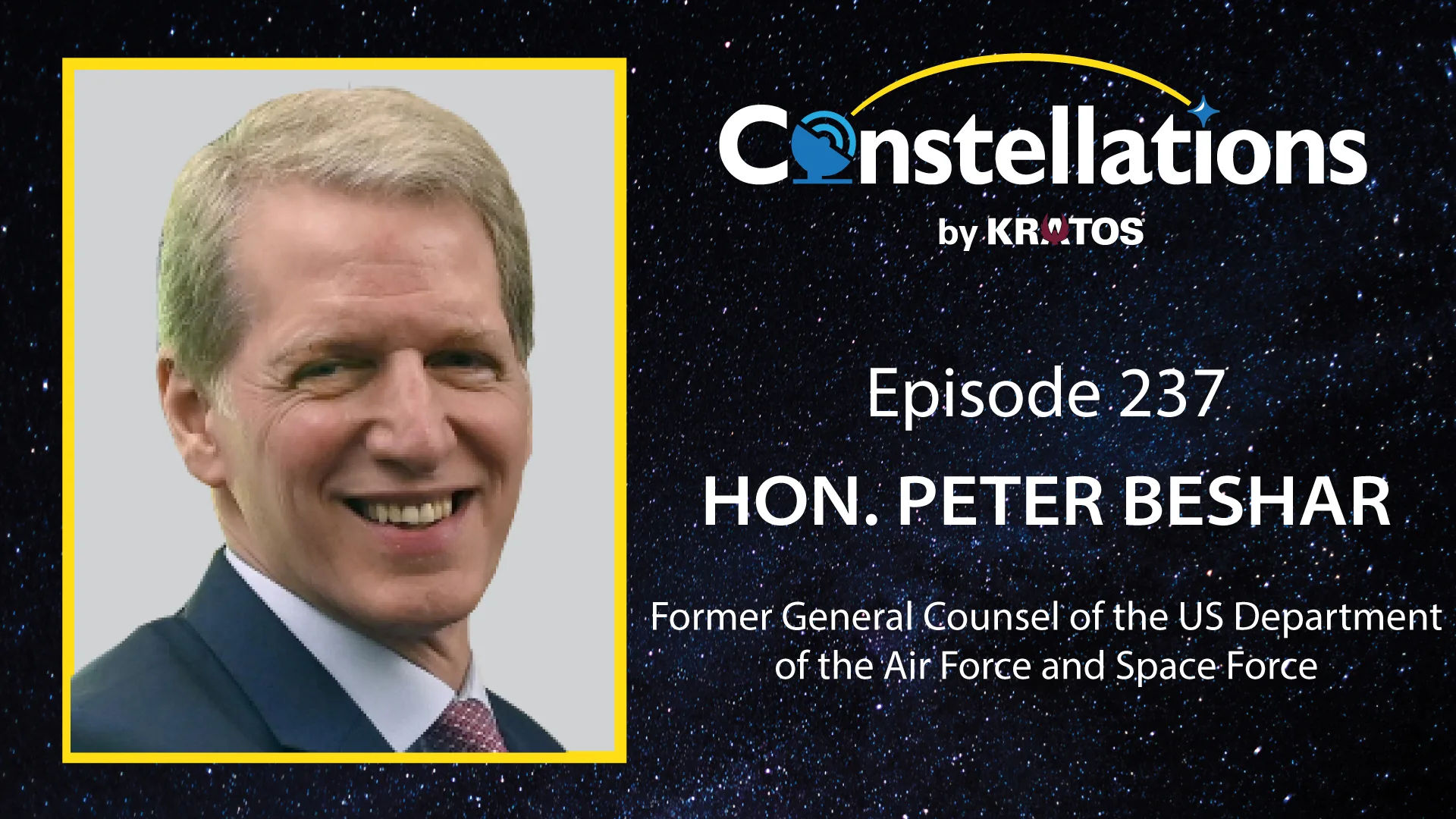
Former U.S. Air Force and Space Force General Counsel Peter Beshar explains why decades-old space treaties must evolve to address commercial space, lunar resource extraction and emerging security threats in an increasingly contested orbital environment.
Hon. Peter Beshar joins Constellations to explore how lunar resource activity, emerging norms and legacy treaties are reshaping responsible behavior and stability beyond Earth.
Boston Consulting Group’s Alessio Bonucci explains why space sovereignty is reshaping global competition, with launch capability, industrial capacity and defense investment emerging as the defining factors in the next generation of national space strategies.
As direct-to-device satellite services move toward commercial scale, operators, regulators and mobile carriers are grappling with how spectrum rights, licensing frameworks and cross-border interference will shape the future of global connectivity. How hybrid use of terrestrial and MSS spectrum is emerging as the most practical path forward, even as questions around sovereignty, regulation and customer control remain unresolved.
The head of the Taiwan Space Agency recently proposed an Asia-Pacific answer to Starlink, kicking off a critical discussion about sovereignty, regional collaboration and the role of commercial partnerships in LEO.
Colonel Tim Trimailo, Director of the Commercial Space Office, drives the Space Force's integration of commercial capabilities into missions. Listen to Colonel Trimailo as he explores how the commercial industry is accelerating the future of military space operations.