Space is a Network.
Constellations is Your Connection.

Market Competition & Strategy

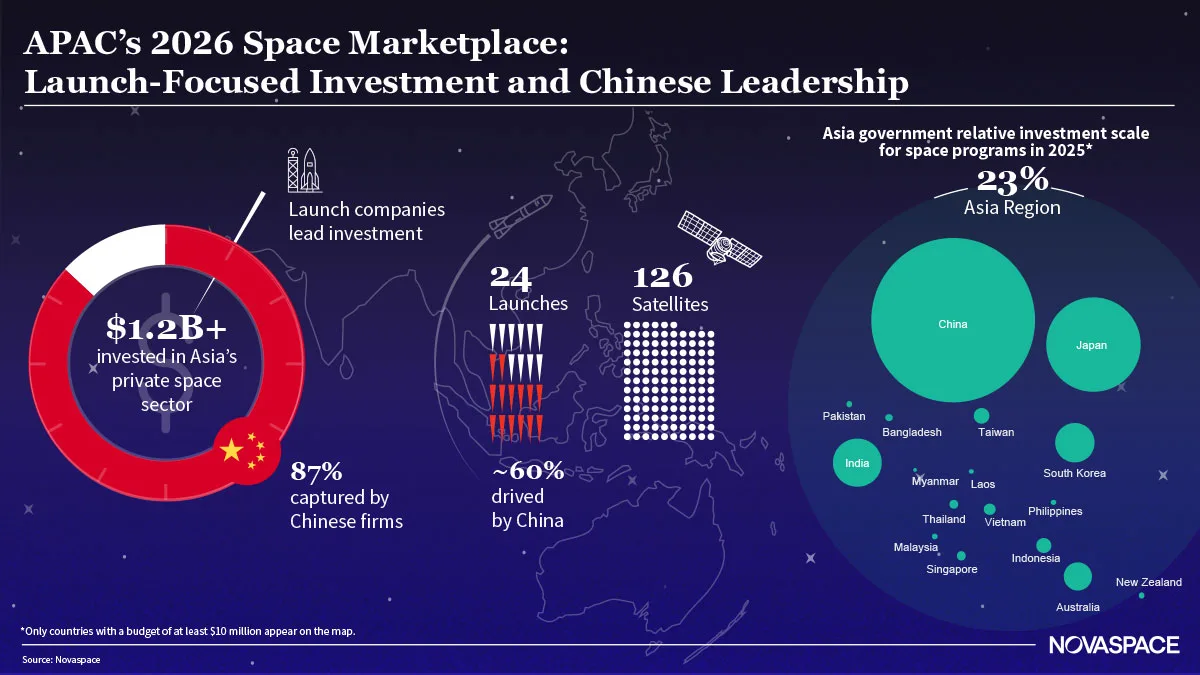
APAC’s 2026 Space Marketplace

As global LEO constellations reshape satellite economics through scale and speed, Middle Eastern operators are charting a different path rooted in sovereignty, regulatory alignment and national strategy. How regional satellite companies are leveraging close ties with governments, multi-orbit collaboration and spectrum stewardship to remain relevant and grow.


The head of the Taiwan Space Agency recently proposed an Asia-Pacific answer to Starlink, kicking off a critical discussion about sovereignty, regional collaboration and the role of commercial partnerships in LEO.

Missile defense systems and autonomous UAVs are converging around a shared need for tighter data integration, AI-driven decision-making and multi-layered network architectures to operate effectively in contested environments. Future resilience will depend on unifying sensing, communication and control into a single intelligent system, while overcoming persistent challenges in interoperability, policy and real-time coordination.

Decades of satellite missions have generated vast amounts of dark data that remain largely unprocessed due to technical complexity, limited funding and a growing gap between data collection and analysis capabilities. Unlocking this data will require AI, improved onboard processing, open-source collaboration and stronger investment in academia and national labs to turn archived information into scientific, commercial and strategic value.

Satellite Connectivity & Technology

Sovereignty Without Borders

As the global space economy evolves, national autonomy is shifting from simple hardware ownership toward total control over the operational stack, including data and networks. Industry experts suggest that hybrid architectures are now the most pragmatic way for nations to maintain security and decision-making authority in an increasingly interconnected orbital landscape.

By prioritizing 3GPP standards and a pay-per-use model, the telco is treating satellite access as a simple roaming extension rather than a standalone luxury. This “one SIM” strategy aims to eliminate vendor lock-in, making space-based data an invisible but essential part of the global mobile ecosystem.

To keep pace with rapidly evolving threats, Colonel Tim Trimailo emphasizes the need to leverage commercial innovation for faster, more agile capability delivery. By breaking down classification barriers and integrating AI-driven autonomy, the service aims to secure a decisive edge in an increasingly contested space domain.

Increasing solar-weather volatility is exposing weaknesses in LEO constellation models, accelerating orbital decay, disrupting traffic management and forcing operators to rethink propulsion, lifecycles and autonomy. In response, the industry is shifting toward more resilient architectures to maintain reliability and reduce systemic risk.

Rising geopolitical tensions and supply chain risks are driving nations to invest heavily in sovereign space capabilities, with thousands of government-backed satellites planned to ensure independent access, resilience and strategic advantage in both military and civilian domains. But while sovereignty strengthens national security, experts warn that fragmentation, interoperability challenges and overreliance on single providers could undermine efficiency and resilience unless balanced with smart alliances and coordinated investment.