



What’s in Store at VOSS
Constellations talked to the Space ISAC team about what to expect from the 2026 Value of Space Summit, what’s new about the event and what they most love about the location.
Space is a Network.
Constellations is Your Connection.
Constellations talked to the Space ISAC team about what to expect from the 2026 Value of Space Summit, what’s new about the event and what they most love about the location.
As Europe accelerates investment in sovereign satellite communications, IRIS², NATO’s HALO initiative and multi-orbit architectures are reshaping how governments balance resilience, security and commercial partnerships.
As AI, cloud computing and cyber threats accelerate the pace of network operations, satellite communications must embrace software-defined, interoperable architectures to keep pace with modern defense and commercial requirements.
As software-defined networking reshapes terrestrial communications, virtualization has become an essential and increasingly accepted foundation for the future of satellite ground infrastructure.

DIFI PlugFest USA 2026 will test the latest version of the DIFI standard in more realistic, end-to-end network environments, helping advance interoperability, certification and digital transformation across next-generation multi-orbit satcom systems.
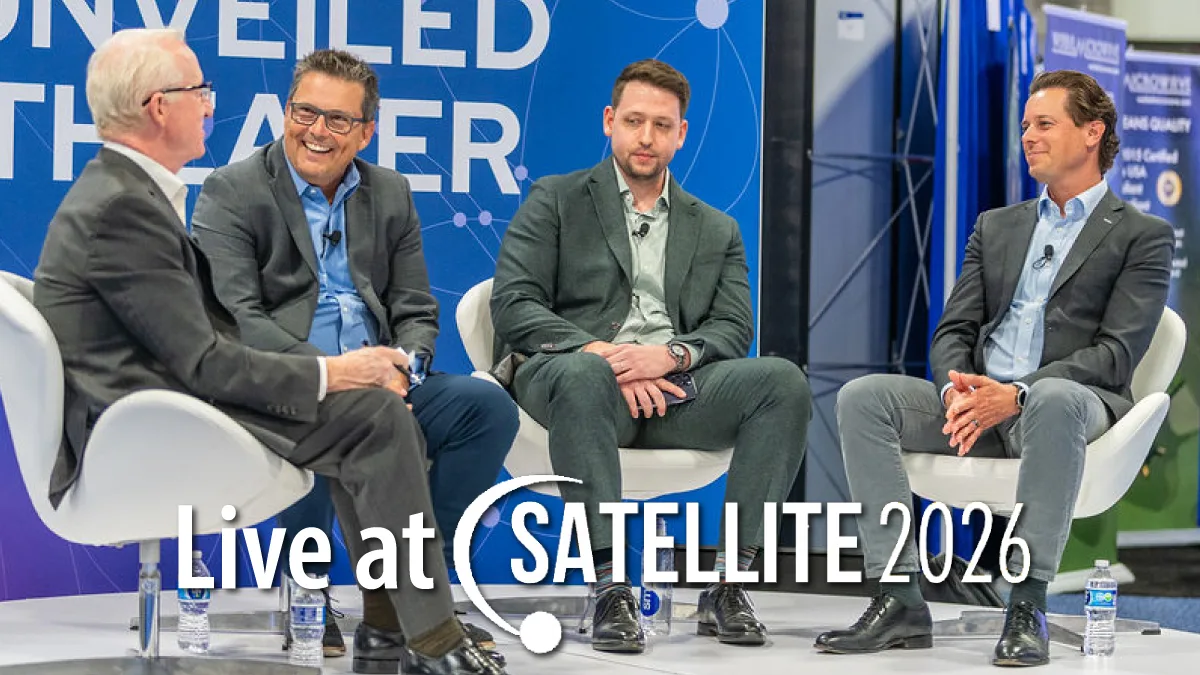
Live at SATshow 2026, Constellations speaks with Blane Boynton of SES, Andrew Cavalier of ABI Research and Greg Quiggle of Kratos on developing long-term 5G NTN strategies, the competitive forces driving ground-system evolution, and how early 5G implementations signal growing commercial readiness.
The head of the Taiwan Space Agency recently proposed an Asia-Pacific answer to Starlink, kicking off a critical discussion about sovereignty, regional collaboration and the role of commercial partnerships in LEO.
By securing Apple as a cornerstone partner, Amazon is officially launching a high-stakes challenge to Starlink’s orbital supremacy. The merger integrates Globalstar’s established spectrum with the “Amazon Leo” infrastructure to bring seamless, high-speed direct-to-device connectivity to the global market by 2028.
The satellite ground segment is evolving into a software-defined, cloud-native control layer that enables seamless integration with terrestrial 5G networks. Andrew Cavalier of ABI Research discusses the role of virtualization, AI-driven orchestration, and new consumption-based models in scaling NTN services and overcoming structural barriers to commercial deployment.
Following lessons learned from the conflict in Ukraine, the 32-nation alliance is moving beyond traditional geostationary leases to integrate LEO, MEO, and HEO constellations for more resilient connectivity. This strategic evolution includes a revamped procurement policy designed to bypass bureaucracy and potentially return NATO to owning its own space-based transponders by 2034.
In our latest interview, ABI Research’s Andrew Cavalier breaks down the latency, cost, and standardization hurdles the industry must overcome to make non-terrestrial networks (NTN) a seamless extension of mobile infrastructure. Discover which players are best positioned to capture value as operators and chipset vendors race to bring satellite connectivity to the mass market.
Operators transitioning to these software-based architectures can achieve nearly 40% in overall cost savings while significantly accelerating deployment cycles for new services. This technological shift is essential for capturing the $30 billion 5G NTN opportunity and ensuring long-term mission adaptability in a rapidly evolving orbital economy.
AST SpaceMobile is accelerating its satellite deployment toward continuous direct-to-device coverage while expanding its ambitions in government and sovereign communications markets worldwide.
While Europe’s HALO and IRIS² initiatives both aim to strengthen sovereign satellite communications, their ultimate success will depend on building interoperable, sovereign-controlled ground infrastructure that enables secure command, connectivity and cross-border operations.
As direct-to-device services evolve beyond basic coverage, balancing terrestrial and mobile satellite spectrum and navigating a complex regulatory landscape will be critical to unlocking the technology's long-term commercial potential.
Orion Space Solutions President Gregg Burgess discusses the architectural, operational and legacy-system challenges facing the U.S. Space Force as it works to integrate space capabilities across air, land, sea and cyber domains to support faster, more effective military operations.
At the 2026 Satellite Show, Constellations spoke with Blane Boynton of SES, Andrew Cavalier of ABI Research and Greg Quiggle of Kratos about developing long term 5G NTN strategies, the competitive forces driving ground system evolution and how early 5G implementations signal growing commercial readiness.
The growing shift toward virtualized, software-defined ground systems is accelerating adoption of interoperability standards like DIFI, enabling satellite operators to reduce dependence on proprietary hardware while supporting scalable multi-orbit networks, 5G NTN integration and future AI-native architectures.
As the global space economy evolves, national autonomy is shifting from simple hardware ownership toward total control over the operational stack, including data and networks. Industry experts suggest that hybrid architectures are now the most pragmatic way for nations to maintain security and decision-making authority in an increasingly interconnected orbital landscape.
While consumer interest in satellite-backed safety features is high, success hinges on moving past “one-size-fits-all” data pricing and industrializing hardware for the high-volume assembly line. Explore how aligning satellite capabilities with automotive roadmaps will finally turn global connectivity into a standard feature rather than a premium option.
The SpaceRise consortium—led by industry heavyweights SES, Eutelsat, and Hispasat—has finally hammered out the compromises needed to secure a multi-billion euro green light for the secure multi-orbit network. While the roadmap includes some technical concessions to hit aggressive 2030 deadlines, the deal marks a massive leap forward for Europe’s strategic autonomy in space-based communications.
Satellite communications are projected to drive nearly half of the $1.8 trillion space economy by 2033. Capturing this growth requires operators to accelerate satellite launches, lower service pricing, and deepen partnerships with mobile network providers.
The facility will begin limited deliveries for Telesat’s Lightspeed constellation later this year before reaching full production in 2027. Built around MDA’s adaptable Aurora platform, the factory aims to drive further orders by churning out both broadband and direct-to-device (D2D) satellites for major clients like Globalstar.
Automation and AI are becoming foundational to 5G non-terrestrial networks, enabling self-optimizing satellite constellations, real-time spectrum coordination, and cloud-native operations that can scale across multi-operator and multi-orbit environments.
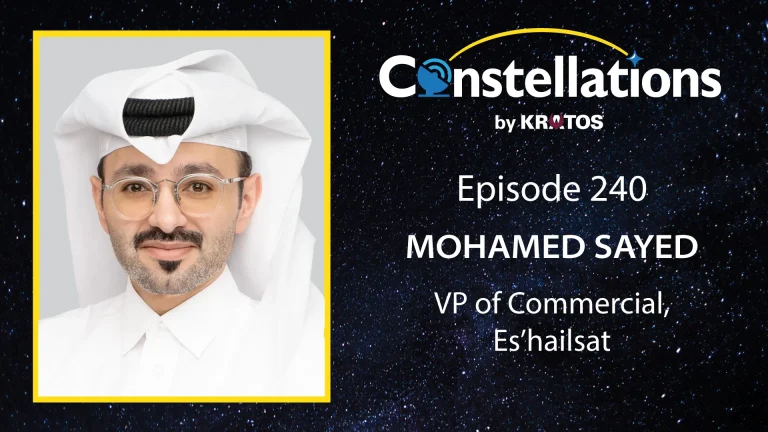
Mohamed Sayed, VP of Commercial at Es’hailsat joins Constellations to discuss how regional operators are navigating a new era of mega-constellations, as governments across the Middle East invest in sovereign space capabilities and secure communications-regional operators will start playing a bigger role.
The European Commission, ESA and the SpaceRISE consortium (SES, Eutelsat and Hispasat) have finalized the implementation agreement for Europe’s IRIS² satellite constellation, resolving months of negotiations over the program’s architecture, cost and governance.
Univity’s proposed broadband and direct-to-device constellation reflects a new approach to satellite connectivity by putting telecom operators—not satellite providers—at the center of the value chain through a shared, wholesale space infrastructure that seamlessly extends terrestrial 5G networks into space.
ABI Research’s Rachel Kong examines how a SpaceX IPO could reshape the satellite industry, accelerating investment in next-generation constellations, direct-to-device services, orbital computing, and the convergence of satellite, telecom, cloud and AI ecosystems.
As direct-to-device satellite services move toward commercial scale, operators, regulators and mobile carriers are grappling with how spectrum rights, licensing frameworks and cross-border interference will shape the future of global connectivity. How hybrid use of terrestrial and MSS spectrum is emerging as the most practical path forward, even as questions around sovereignty, regulation and customer control remain unresolved.
Novaspace’s Nathan de Ruiter shares why the industry is moving past speculation toward real-time execution in areas like sovereign connectivity and multi-orbit strategies. Read the full interview to understand how operators are navigating a fragmented landscape defined by local regulation and the convergence of satellite and terrestrial networks.
By prioritizing 3GPP standards and a pay-per-use model, the telco is treating satellite access as a simple roaming extension rather than a standalone luxury. This “one SIM” strategy aims to eliminate vendor lock-in, making space-based data an invisible but essential part of the global mobile ecosystem.
The approval of a certification program for the DIFI 1.1 standard marks a key step toward greater interoperability and trust in digital IF equipment, enabling both standardized performance assurance and independent third-party validation. As virtualization and cloud-based ground systems expand, DIFI compliance and feature-based certification will make it easier for organizations to specify, deploy and scale interoperable solutions.
As the United States reshapes its military space posture for a more contested orbital environment, it is emphasizing proliferated satellite architectures, closer integration with commercial industry and more flexible acquisition strategies to sustain operational advantage. At the same time, analysts warn that long-term strategic planning, industrial capacity in space and clearer capability signals to industry will be critical to ensuring resilience, deterrence and mission effectiveness in future conflicts.
The physical attack on an SES gateway in Israel marks a turning point in how we view satellite infrastructure, shifting the focus from cyber threats to the urgent need for kinetic resilience. By adopting standards like DIFI to virtualize and distribute ground segment operations, organizations can ensure connectivity remains seamless even if a specific physical site is compromised.
This article breaks down four vital takeaways driving the industry's next growth curve, from fierce spectrum land grabs to the game-changing scale of Low Earth Orbit (LEO) deployments. Click the link to uncover how the clash between proprietary systems and emerging 6G standards will reshape global connectivity.
CEO Matt Desch is finally playing the valuation game, signaling openness to mergers or alliances to command the premium multiples currently assigned to direct-to-device hype. Beyond the spectrum positioning, the firm operates as the baseline fallback network for aviation and government infrastructure, offering an embedded hedge against broader market exuberance.